
Why a cat under a moon? The pairing has survived four thousand years of changing iconography, and is one of the oldest household images Western and East-Asian art share. From the lunar disc above Bastet’s temple at Bubastis, through the cool ink-and-wash skies of Edo-period Japan, to the pale moonlit canvases Léonard Foujita painted in 1920s Paris, the cat-and-moon has carried, almost without interruption, the same emotional charge: solitary watchfulness, the dignity of being awake when the rest of the household sleeps. My own Moon collection is a Paris-born contribution to that long descent, and the essay below traces the genealogy that produced it.
Why are cats so often paired with the moon?
Two reasons recur across cultures, one naturalistic, one symbolic. Cats are crepuscular: their hours of greatest activity fall between dusk and dawn, the hours when the moon is most legibly above the horizon. A cat sitting in a window at three in the morning is, more often than not, lit by lunar light. Painters since antiquity have observed this and put it on canvas.
The symbolic reading reinforces the naturalistic one. Cats have long been read across cultures as creatures of intuition, secret knowledge, and quiet sovereignty — qualities the moon has carried in poetry and myth since the earliest written records. The lunar cat is therefore the image that answers a real question: what does it look like to be both alone and watched? In European folklore, in Japanese ukiyo-e, in modern fashion illustration, the cat-and-moon motif keeps returning because no other animal performs the answer quite as economically.
The lunar cat in art history
Egypt and Bastet
Bastet, the cat-headed goddess of ancient Egypt, presided over hearth, fertility, and the safe passage of the dead from the Late Period onward (664–332 BCE), with her principal cult centre at Bubastis in the Nile Delta. Surviving bronze figurines and reliefs sometimes show her wearing a sun disc — she sat largely within the solar family of deities — but the temple precinct kept cats on the grounds and mummified them at death, and the cult’s nocturnal rituals associated the cat-form with night-watching as well as day-warming. Whether Bastet herself ever became a lunar deity in any strict sense is contested among Egyptologists; what is certain is that the cat-form she gave the Mediterranean world carried into later art the idea of a domestic guardian-figure suspended between household and sky.
Japanese ukiyo-e
The pairing reaches its most refined Western-recognisable form in Edo-period Japan. Utagawa Kuniyoshi (1798–1861), the great ukiyo-e cat artist, produced numerous prints in which cats sit beneath moons, walk along moonlit paths, or are themselves drawn in feline-moon hybrids. Utagawa Hiroshige (1797–1858) included in his One Hundred Famous Views of Edo the celebrated Asakusa-tanbo Torinomachi mode (1857), in which a single white cat looks out a paper-screen window onto the rice fields of Asakusa, with paper lanterns and the distant Yoshiwara district below: not strictly a moonlit scene, but a lunar register all the same — the cool light, the elevated solitude, the calm vigil of an animal in a high window. The print became, after its arrival in nineteenth-century Paris through the Japonisme wave, one of the visual ancestors of the modern Western painted “moon cat”.
Foujita and Paris
Léonard Tsugouharu Foujita, arriving in Paris in 1913 with the Japanese formal tradition fully internalised, became the great twentieth-century painter of lunar cats. His pale, ink-line, thinly-washed canvases of the 1920s and 1930s treated the moon less as an explicit motif than as an atmospheric ground: Foujita’s cats are lit as if by moonlight even when no moon appears, and the lunar tonal climate is absorbed into the palette itself. Any contemporary painter who works the cat in cool nocturnal tones — including me — is descending, knowingly or not, from Foujita. I write about Foujita’s place in the wider cat-painting tradition in my short history of cat painters.
How I paint the lunar cat
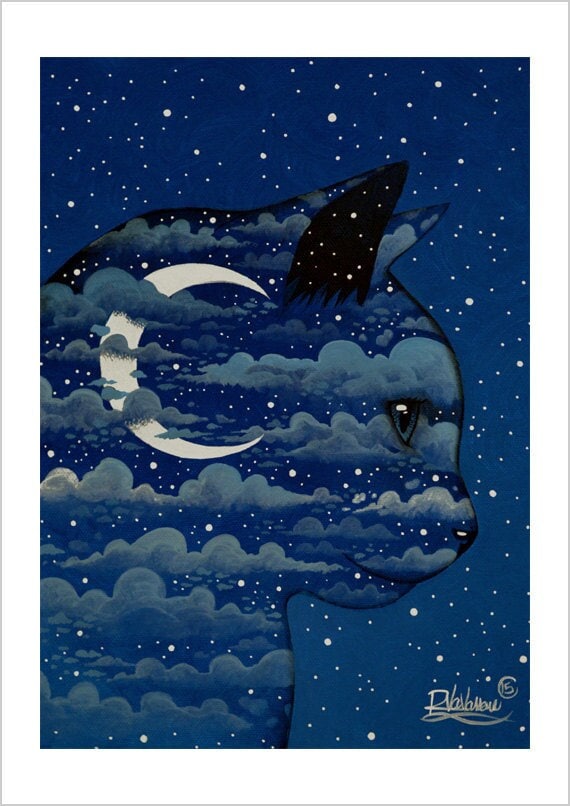
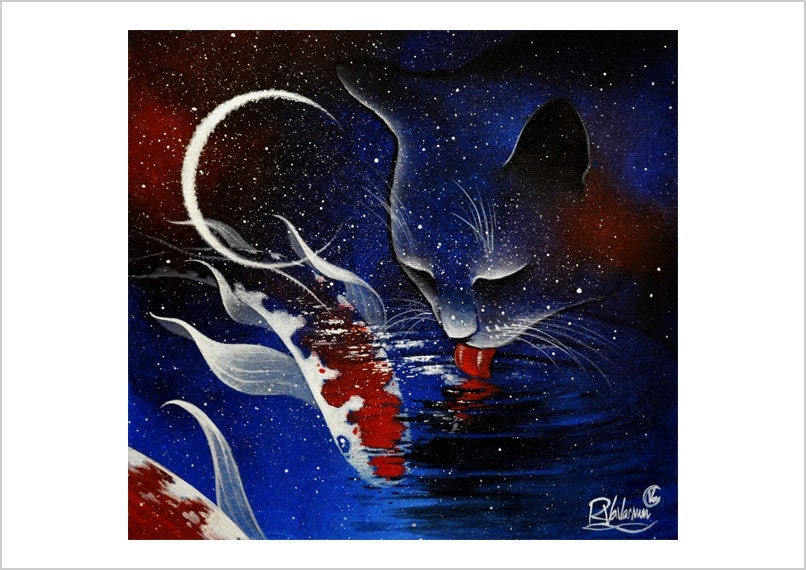
My Moon collection works in muted nocturnal tones: cool whites, pale silver-greys, deep ink blues, and a touch of warmth at the horizon. The cats sit on rooftops, walk through pale countrysides, observe the moon from low windowsills. Pieces such as Cosmic bath, Three moons, and Moon cat exemplify the collection’s vocabulary. The originals are acrylic paintings on canvas with a soft satin varnish; the fine art prints retain the tonal range of the originals as faithfully as photographic paper allows.
The work belongs to the same tonal family as Foujita and nineteenth-century French ink-and-wash drawings, but my touch is softer, slower, more domestic. My lunar cats are not symbolic creatures so much as small companions caught in moonlight — sometimes alone, sometimes with a human figure half-asleep beside them, sometimes paired with another cat in subdued contact. The image carries the whole mythography without explicitly invoking it. My three studio cats are, in a restrained way, the originals from which most of the lunar postures are observed.
Where to hang a moon cat in the house
Bedrooms above all — the palette is dusk-bound and the imagery is restful — but also any room that comes alive after dark: a library lit by a single lamp, a kitchen used at night, the corridor between bedroom and bathroom. Cool wall colours flatter the series; warm ones offer pleasant tension.
The lunar prints pair naturally with the Cosmos collection (constellations and stars enter the same after-dark vocabulary) and the Paris collection (Parisian rooftops in night light). For a bedroom of pale linen and natural wood, a single medium moon print above the headboard is usually the right move; for a darker bedroom, a vertical lunar piece beside the bed performs better. Room-by-room mathematics — sightline height, scale rules, frame choice — live in my placement guide.
Three recurring compositions in my Moon collection
A close look at three motifs in the Moon collection clarifies what the lunar cat is doing on the wall and why the imagery survives across decades of changing interior fashion.
The rooftop watcher
A single cat seated on a rooftop or windowsill, neck slightly extended, watching a moon that fills the upper third of the canvas. The pose descends from the high-window vigil of Hiroshige’s Asakusa-tanbo Torinomachi mode (1857) and is refined through Foujita’s Parisian feline portraits of the 1920s. The cat is alone but unhurried; the moon is large but unthreatening. The pairing creates a feeling of still vigil that almost no other animal-and-environment image produces with the same economy.
The lunar pair
Two cats side by side under a moon, often with one larger than the other — mother and kitten, two adults in repose, or a pair whose ages are deliberately ambiguous. The composition reads as tenderness, companionship, and the particular intimacy of shared night-bound hours. Pieces of this kind tend to live longest in bedrooms and reading rooms; they also work well as gifts for couples and parents.
The walking cat
A small cat walking across a pale countryside or empty foreground, the moon hanging above as the only other figure in the scene. The image draws on a long literary tradition. Matsuo Bashô (1644–1694) wrote a number of feline haiku — the spring-season “cat’s love” haiku in particular — and other Edo-period poets paired cats with the moon explicitly. T.S. Eliot, three centuries later, gave English-speaking readers the “Jellicle Moon” in Old Possum’s Book of Practical Cats (1939). The walking-cat composition renders all of that as a single durable image of solitary travel under a generous sky.
The moon cat as gift
Lunar feline prints land particularly well as gifts — for births, anniversaries, retirements, milestone birthdays — because their imagery is universally readable but never sentimental. They suggest care without requiring explanation. The recipient does not need to be a cat-owner to receive the work properly. The Moon collection is one of the most frequently chosen gift collections I have, precisely for this reason.
It is also one of the collections most often bought for grief: collectors writing in after losing a cat will frequently choose a lunar piece — the nocturnal palette and the figure of a cat watching from a window read as consolation without explanation. For occasion-by-occasion guidance, see my gift guide; for those who want to push the gesture further, an original cat paintings in the lunar tonal family carries the weight that milestones — or memorials — deserve.
Where to find the collection
The full Moon collection is offered as fine art prints in several sizes, dispatched from France with international tracking, the prints sent between two rigid boards so they arrive unbent. Originals — one-of-a-kind acrylic works on stretched canvas, sealed under a low-sheen varnish — appear in the original cat paintings when available and tend to leave the studio quickly. Browse the wider fine art cat print catalogue for the seven further collections in the studio’s tonal idiomatic range. Pieces from the Moon collection, the Black & White collection, and the Cosmos collection constitute the late-hour core of my work, and many collectors own pieces from all three. For commissions or to follow new pieces before they are listed, find me on Instagram at @raphael.vavasseur.art.