Cats appear in painting almost everywhere they appear in human life: as companions, as compositional anchors, as portraits unto themselves. The short history below traces a single thread — the European and trans-Pacific tradition of treating the cat as the subject in its own right — from the late-nineteenth-century Parisian rehabilitation through Foujita, through the twentieth century’s several branchings, and finally into my own studio in France. It is not a complete history; it is a usable one, and it is the lineage I work inside whenever I begin a new painting.
Cats in Western art before the cat painter
Cats slipped through European painting for centuries as supporting figures. They appear at the feet of Madonnas in fourteenth-century Italian altarpieces; beside Venetian noblewomen in Renaissance portraits; asleep on the floors of seventeenth-century Dutch interiors by Pieter de Hooch and Jan Steen; in Pierre-Auguste Renoir’s 1887 Julie Manet (Child with Cat), where the small cat in the sitter’s arms is co-protagonist instead of detail. They were rarely the centre of the picture; they were part of the room.
Two paintings mark the beginning of the shift. Manet’s Olympia (1863), now at the Musée d’Orsay, places a small black cat at the foot of the reclining nude, tail raised, posture alert — a presence so charged that several 1865 critics found it more shocking than the nude itself. The cat is no longer furniture; it is co-protagonist. Pierre Bonnard, working in the 1890s and early 1900s, treated his domestic cats with the same compositional weight as his human subjects, painting The White Cat (1894, now at the Musée d’Orsay) as a single full-canvas portrait. These pictures inaugurated the modern cat painting. I write about the black cat’s longer symbolic lineage in my black-cat essay.
The 1890s: Steinlen and the Parisian rehabilitation
The painter who most decisively made the cat a standalone graphic subject was Théophile-Alexandre Steinlen, the Swiss-born French artist whose 1896 poster for the Montmartre cabaret Le Chat Noir became one of the iconic Belle Époque images. The poster — a single coal-black cat, head haloed, standing in full silhouette against ochre and red — reframed the black cat almost overnight, from creature of folkloric suspicion to figure of bohemian intelligence, urban modernity, and graphic confidence.
Steinlen’s subsequent prints, drawings, and lithographs — collected by 1898 into the album Des Chats — established the cat as a respectable, repeatable artistic subject. Cats appear in his work in every domestic situation: napping, fighting, courting, hunting, gathered in flocks on Parisian rooftops. By the time of his death in 1923, Steinlen had painted or printed more cats than perhaps any other Western artist before him, and the genre he had effectively invented — the cat as freestanding subject of fine art — was in place.
Foujita and the Paris school
Léonard Tsugouharu Foujita (1886–1968) arrived in Paris from Japan in 1913 and within a decade had become the city’s great painter of cats. His feline portraits — pale, glassy-eyed, often domestic, drawn with the fine ink line of Japanese tradition over thinly washed canvas — remain the high point of the genre. Across the 1920s and 1930s Foujita produced dozens of cat portraits and self-portraits with cats, extending what Steinlen had begun, with the additional dimension of East-Asian formal tradition fully internalised.
Foujita’s 1930 illustrated volume A Book of Cats, a portfolio of twenty cat etchings with poems by Michael Joseph, is one of the rare twentieth-century books that has held its monetary value as art, not as commodity. The original folios fetch four-figure prices at auction; the imagery within them remains a touchstone for any painter working the cat as quiet, dignified, lightly mystical subject. Foujita is the formal grandfather of much that follows. Any contemporary cat painter who works in cool nocturnal palettes with fine ink line — including me — is descending, knowingly or not, from him.
After Foujita: twentieth-century branchings
Klee, Balthus, and the Surrealist register
Paul Klee’s 1928 Cat and Bird, now at the Museum of Modern Art in New York, gave the feline an almost geometric, abstracted face. Balthus’s 1935 self-portrait The King of Cats (Musée cantonal des Beaux-Arts de Lausanne) painted the cat as familiar, companion, occasionally alter ego. The interwar surrealists and their adjacent figures — Suzanne Valadon, Maurice Utrillo — kept the cat inside household interiors but treated those interiors with new strangeness.
Warhol and Pop
Andy Warhol’s 1954 portfolio 25 Cats Name[d] Sam and One Blue Pussy, lithographed by Seymour Berlin in a limited edition for friends, recast the cat in Pop iconography. The text was hand-lettered by Warhol’s mother, Julia Warhola; the cats were rendered in saturated single-colour washes. The portfolio belongs simultaneously to the cat-painting tradition and to the Pop tradition that Warhol would consolidate in the 1960s; it is the moment when the cat enters mass-market graphic art on its own terms.
B. Kliban, Edward Gorey, and illustration
B. Kliban’s 1975 book Cat sold over a million copies and transformed the cat from fine-art subject into mass-market graphic property. Edward Gorey’s gothic, pen-and-ink cats — recurring across his 1960s and 1970s books — carried the cat into a darker, more literary register. By the late twentieth century the cat had become an entirely respectable centre of a picture, not a footnote inside one.
Where my own studio sits in this lineage
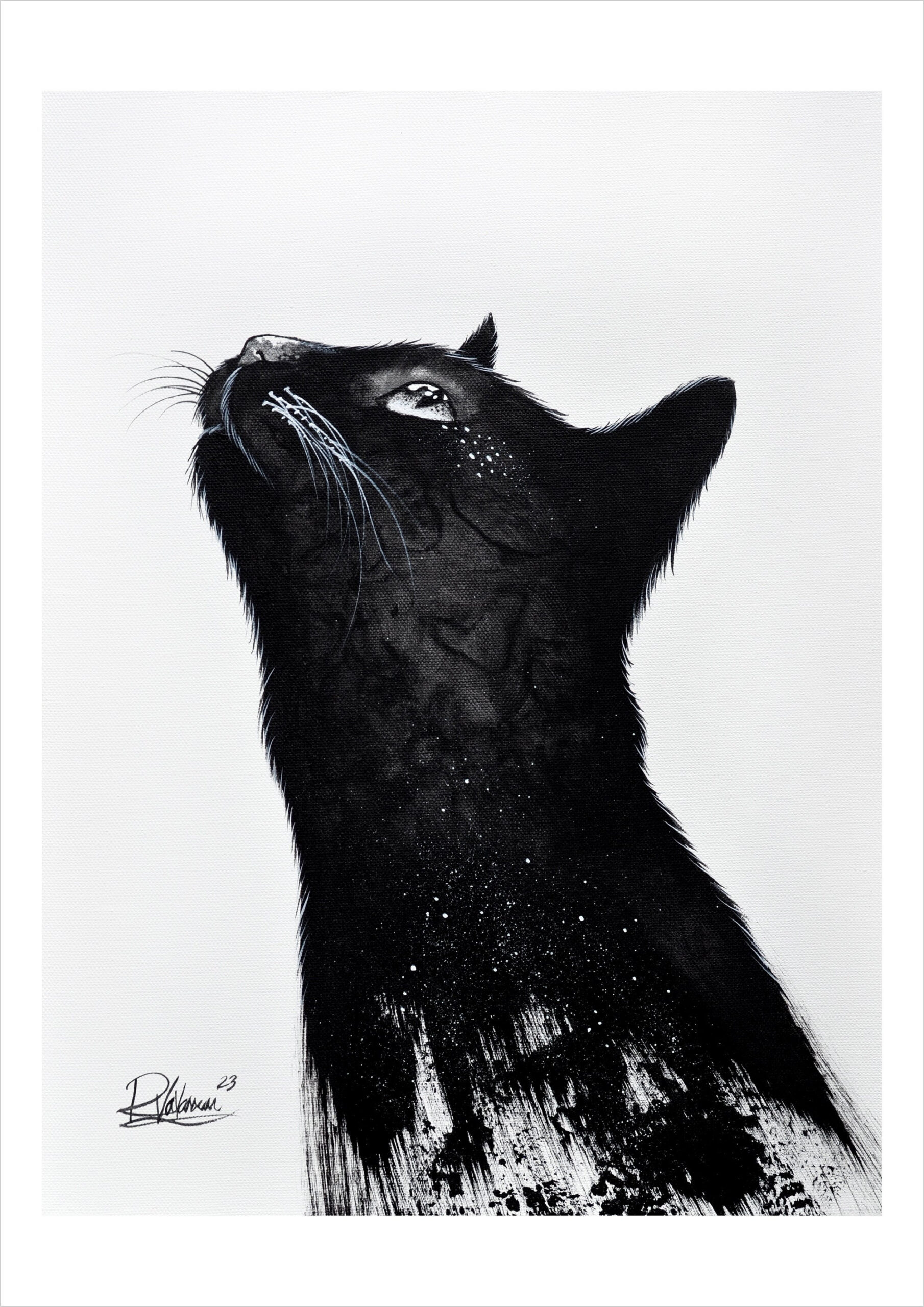
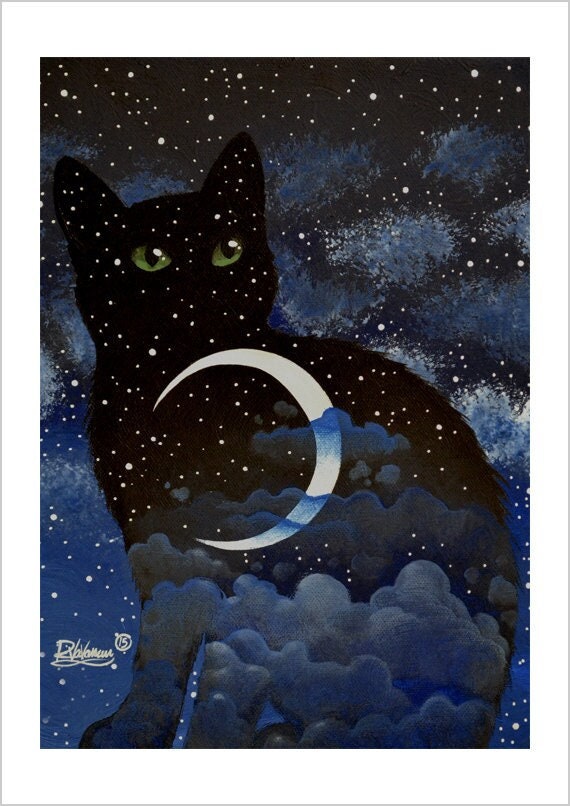
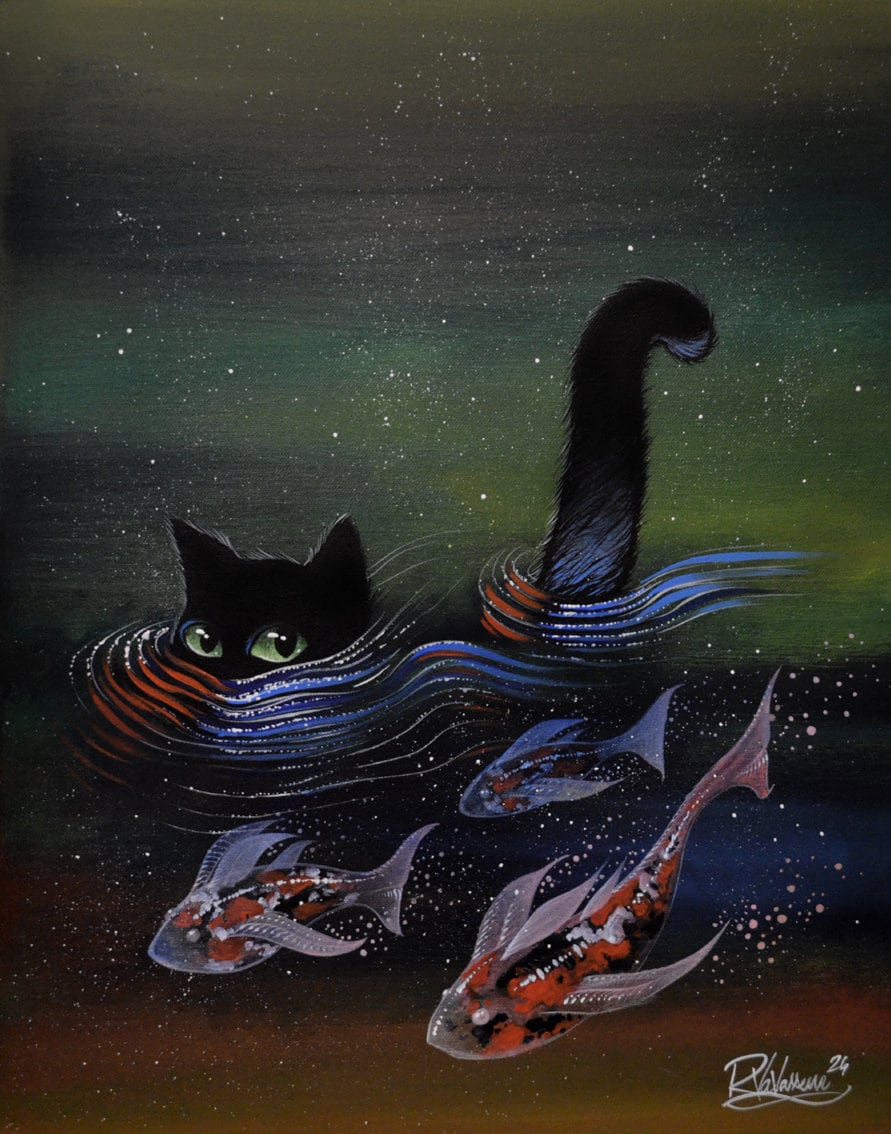
I work in France today, and I extend the cat-as-portrait tradition in a personal direction. My originals are acrylic on stretched canvas, finished with a soft satin varnish, in palettes that lean nocturnal: cool whites, deep night blues, sepia, charcoal, gentle pinks and creams in the softer collections. The cats are typically small in the composition, framed by lunar skies, constellations, Parisian rooftops, dreamy cloud-fields, or simply empty atmospheric grounds. My three studio cats are part of the work in a muted way — they keep watching me paint, and I keep painting cats who keep watching.
The vocabulary owes its line to Foujita, its hushed drama to Steinlen, and its tonal range partly to East-Asian ink painting; but the emotional centre is my own. Cats appear in my paintings as witnesses to human feeling — titles like The other takes care of me, Alf makes peace with cat, and Blind love testify to the recurrence of the human-feline pairing — and the cat’s composure is what gives the pictures their weight.
The studio works in two principal formats: the original cat paintings, one-of-a-kind acrylic-on-canvas pieces under a low-sheen protective coat, signed and dispatched from France with international tracking, and the fine art cat print catalogue, fine art editions spanning eight collections (Black & White, Moon, Cosmos, Cloud, Soft, Magic, Paris, Digital). Both formats carry the same tradition into rooms that exist now. I discuss the choice between them in my originals-vs-prints article.
Why this lineage matters when buying
Buying within a tradition is not an academic exercise — it changes the work’s presence on a wall. A cat portrait that descends from Foujita, Steinlen, and East-Asian ink painting reads on the wall as inheritance rather than novelty. It will continue to read that way in ten and twenty years. The decorative trend cat-art that dates within a season is precisely the work that has no ancestry to draw on; the painting whose ancestry runs back to Manet, Bonnard, Foujita, and Klee remains itself across decades.
The Black & White collection carries the Steinlen and Foujita inheritance most directly; the Moon collection and Cosmos collection extend the Egyptian and Japanese cosmographic tradition; the Paris collection honours the Parisian school in which Foujita, Steinlen, and Bonnard all worked. Visiting the shop is, in a small way, entering the contemporary chapter of a long picture-making project.
Where to enter the tradition
If you are buying your first cat painting — print or original — choose the collection whose tonal family resembles the painting tradition you are most drawn to. Foujita admirers will find the Black & White collection and Moon collection closest to home; Steinlen admirers will find the Paris collection and Black & White collection. For Klee or Surrealist sensibilities, the Digital collection and Magic collection offer the closest contemporary mood. For the question of how to choose — collection, format, scale, palette — see my full guide.
The studio catalogue now contains over 340 paintings, prints, and canvas works, and the pieces have travelled into homes in France, Germany, Italy, the United Kingdom, the United States, and Australia, among other countries. On the studio’s Etsy shop the work currently sits at a 4.96-star average over more than 1,200 verified reviews — not a marketing claim but the slow accumulation that lets a buyer judge whether a small contemporary studio is reliable. For commissions or to follow new work, the studio is on Instagram at @raphael.vavasseur.art.