
“Mystical cat art” is a phrase that has settled into common use, and like most useful phrases it is slightly imprecise. The essay below is the working definition I use myself, in my studio in France, when collectors ask what makes a feline image read as mystical, not merely decorative. The aim is not to defend the term but to make it useful: to specify what one is actually buying when one buys a mystical cat painting.
A working definition
Mystical cat art is feline imagery that treats the cat as a creature of inwardness — not personality. The cat is rendered less as character (clever, playful, mischievous) than as small custodian of an atmosphere: lunar, celestial, dreamlike, quietly ritual. The result is art that looks like a portrait but reads like a poem.
That distinction matters. Decorative cat illustration leans on the recognisable behaviours of cats — the alert ear, the wide-eyed stare, the bottle-brush tail. Mystical cat painting leans on the unrecognisable interior of cats: the part of them that watches the room from a corner, that follows weather across a window, that knows when something is about to happen. The first asks the viewer to laugh or to recognise; the second asks them to wait.
John Keats coined a phrase in 1817, in a letter to his brothers George and Tom, that names the temperament well: “negative capability” — the capacity of an artist to remain in “uncertainties, mysteries, doubts, without any irritable reaching after fact and reason.” Keats was talking about Shakespeare’s openness to ambiguity. The analogy I am pulling here is that mystical cat art performs, on the wall, the same kind of suspension: the cat is doing something, the viewer does not know what, and the painting does not say. It invites the same kind of patience.
The recurring motifs
Lunar and stellar imagery
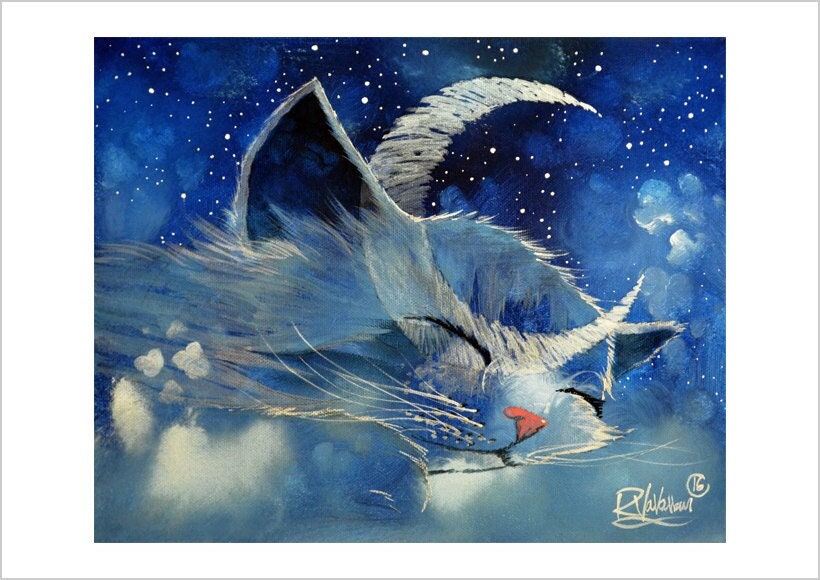
Moons, constellations, scattered stars, soft halos. The Moon collection and Cosmos collection carry these motifs most explicitly. Their effect is to scale the cat: a small body framed by a vast night, the disproportion held by the cat’s composure rather than disrupted by it. The lunar register is older than the modern label “mystical” — it descends from the Egyptian iconography of Bastet and from Edo-period Japanese woodblock prints — but its persistence in contemporary cat art testifies to the legibility of the pairing. I write about it at length in my lunar-cat history.
Ritual and symbolic objects
Sigils, runes, ribbons, hidden plants, small painted gold motifs that catch oblique light. The Magic collection collects these. The signs are never overt occult symbols; they hover at the edge of legibility, suggesting that the cat belongs to a small private mythology, not a public religion. Pieces such as The aura of the sphynx cat, The dark city of the cat, and The sweet dream of the indigo cat exemplify the idiom.
Monochrome ink-wash treatment
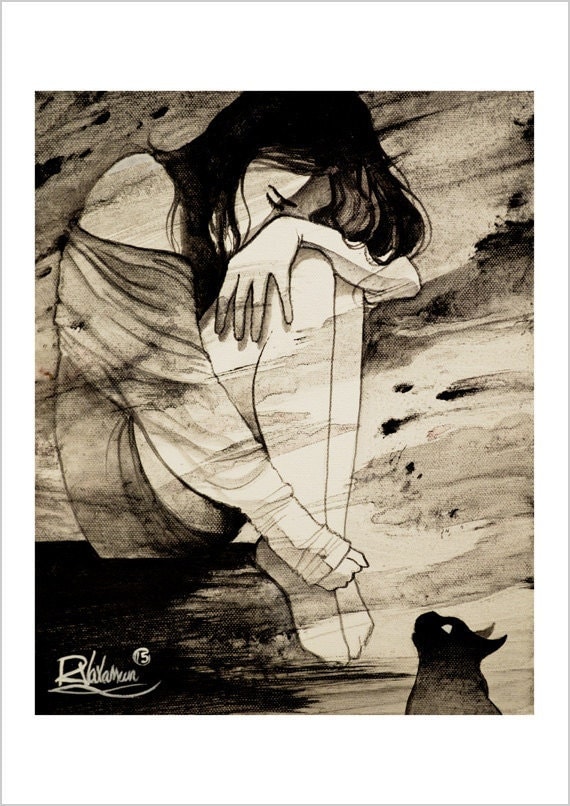
Reduced palette, strong silhouettes, brushwork inherited partly from East-Asian ink painting. The Black & White collection carries this register most cleanly. Removing colour reveals what the image is really about: rhythm, posture, gaze. The lineage runs through Hiroshige, Kuniyoshi, and Foujita, who carried the ink tradition from Tokyo to Paris and absorbed it into Western painting.
Tender intimacy with human figures
In many of my works — from titles like The other takes care of me, Alf makes peace with cat, Blind love, and United — a cat sits in close emotional proximity to a human figure. The cat’s role is witness, not protagonist. This recurring relation anchors the mysticism: the cat attends to what is happening, and does not look away. The image becomes, softly, a study in grief, in care, in the particular consolation an animal offers a person. With three cats in my own studio observing the work in progress, the witness pose is something I encounter every day.
Compositional restraint
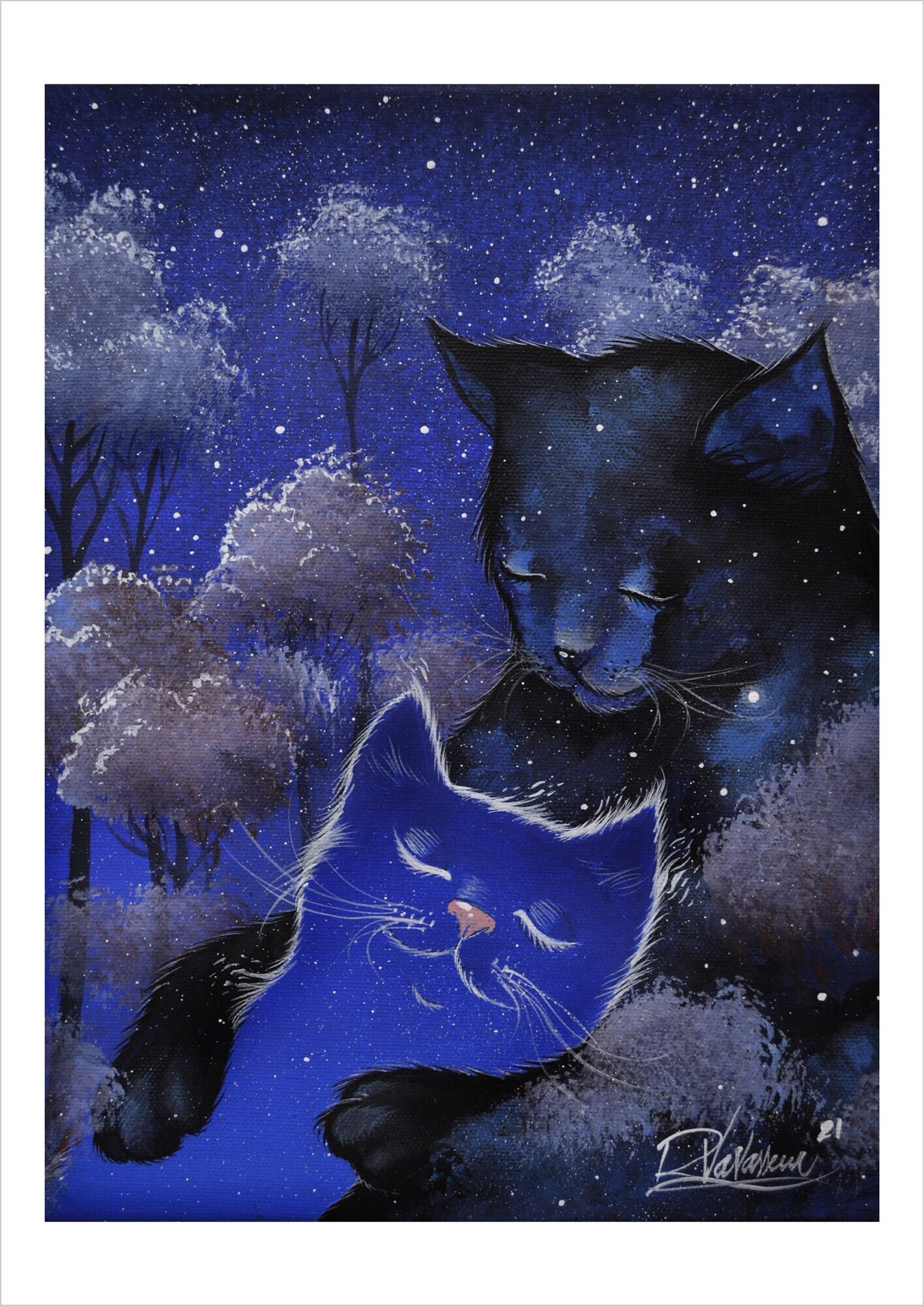
Mystical feline work tends toward muted, cool, nocturnal palettes — deep blues, sepia, charcoal, cream, occasional gold or red as a single accent. Saturation is restrained; light is often suggested — not depicted. The atmosphere is end-of-day rather than midday. That formal restraint is part of the mysticism. A loud palette would explain too much. A quieter one leaves room for the viewer to feel that something has been suggested, not told.
Palette and atmosphere
If I had to summarise mystical cat art in a single chromatic instruction, it would be this: choose every colour decision in the direction of subtraction — not addition. The strongest pieces in the tonal climate are built from a very narrow palette, often three or four tones, with one small accent (gold leaf, a red ribbon, the white of a moon) functioning as visual punctuation rather than competing voice.
This restraint creates the mood the term keeps returning to. The viewer encounters a unified tonal world, not a collection of objects in a room. The cat is not surrounded by its setting; the cat is part of its setting. That structural unity is what makes the work read as mystical, not merely decorative.
The longer lineage I am working inside
Mystical cat art is not a new genre. It descends, in different proportions, from several streams that converged in the late nineteenth century. The Egyptian iconography of Bastet — cat as guardian of the threshold — supplied the underlying gravity. The Edo-period Japanese tradition of cats in domestic and natural settings, particularly the work of Utagawa Kuniyoshi (1798–1861), supplied the formal vocabulary: economical line, active negative space, posture as character. The European Symbolist movement of the 1880s and 1890s — Odilon Redon, Pierre Puvis de Chavannes — supplied the atmospheric tonal family: muted palette, dreamlike scale, emotional — not narrative content.
Foujita, arriving in Paris in 1913 carrying the full Japanese tradition, synthesised these streams into the modern feline portrait. Contemporary painters working in mystical cat art — including me — descend, directly or indirectly, from that synthesis. I trace the lineage in detail in my short history of cat painters.
Distinguishing mystical from sentimental
The most reliable test for whether a piece of cat art is genuinely mystical or merely sentimental is to ask: what does the cat appear to know? A sentimental cat painting depicts a feeling about the cat — tenderness toward it, affection for its softness or its silliness. A mystical cat painting depicts a knowledge in the cat — something the cat appears to be witnessing, attending to, or holding. The first asks for the viewer’s heart; the second asks for the viewer’s attention.
Sentimental work tends to centre the cat’s face and large eyes (the configuration that triggers caregiving response in human viewers, identified by ethologist Konrad Lorenz in his 1943 paper on innate releasing mechanisms under the term Kindchenschema). Mystical work tends to under-emphasise the eyes and to centre the posture — the angle of the ear, the curve of the back, the alertness of the tail — because posture carries more inwardness than expression. A piece that survives the Kindchenschema reduction (looks adult, alert, slightly austere) is almost always working in the mystical mood; a piece that requires the wide-eyed gaze to land is more often than not working in the sentimental one.
This is not a hierarchy. Sentimental cat art has its own legitimate audience and its own pleasures; my Soft collection and Cloud collection include pieces that lean tender, and they belong on walls in homes where tenderness is the right idiom. The distinction matters only because the two kinds of work do different jobs, and a buyer who wants one but acquires the other tends to lose the work to the wall within a year.
Why this body of work resonates now
In an interior culture saturated with high-saturation imagery and decorative excess, the mystical cat painting offers an unusual proposition: a slight figure, a vast ambience, a quiet gaze. It belongs to a long European and Asian tradition while addressing rooms that exist now. The work performs particularly well in spaces designed for slow occupation — reading rooms, bedrooms, libraries — rather than the more transactional spaces of contemporary life. It is, in the precise sense, art for staying with.
Where to find work in this register
The original cat paintings and the eight fine art cat print catalogue collections in my catalogue offer different entry points into the same world. The Moon collection and Cosmos collection carry the lunar and astronomical register most explicitly; the Magic collection carries the ritual mood; the Black & White collection carries the monochrome ink-wash idiom. Many collectors of mystical cat art own pieces from three or four of these collections, since the tonal family is consistent across the range. The shop consolidates the studio archive for browsing. For commissions, the studio is on Instagram at @raphael.vavasseur.art.