
Most of the pieces that leave my studio in France leave as gifts. They are bound for a friend, a parent, a grieving acquaintance, a newlywed home, a recently retired colleague — rather than for the buyer’s own wall. Cat art turns out to be an unusually durable kind of gift: intimate without being too personal, beautiful without being too extravagant, meaningful without needing explanation. The short guide below is the advice I would give over the studio table, drawn from years of helping collectors choose the right piece for someone they care about — matched by recipient, by interior, by occasion.
Who is cat art a good gift for?
In practice, cat art lands well with several recognisable recipients. Long-time cat-owners (who recognise the small physical gestures of the animal in the work). People in transition — new homes, milestone birthdays, retirements — who need a small permanence on their walls. Friends grieving a lost animal who want something gentle rather than literal. Anyone whose taste leans toward illustration, art history, or quiet domestic objects.
It is, importantly, also a gift for non-cat-owners. My feline images are art first and cats second — they bring graphic intelligence and a particular emotional register, not a hobby. A recipient who has never lived with a cat will still respond to the lunar atmospheres of the Moon collection or the architectural calm of the Paris collection, because what the work offers is mood — not pet portraiture.
How I would choose the right piece
Match the recipient’s palette, not their cat
The most common gift error is to try to match the recipient’s living animal. The best gift will not look like the recipient’s actual cat; it will fit the recipient’s actual home. Browse with their interior in mind: cool tones suggest the Moon collection or Paris collection; warm tones suggest the Soft collection or Cloud collection; bold graphic interiors suit the Black & White collection or Digital collection; layered, bookish, lamp-lit rooms welcome the Cosmos collection or Magic collection.
If you cannot remember the recipient’s walls clearly, choose monochrome or pale tones; both flatter almost any interior and rarely produce regret. The collection-by-room logic is in my guide to choosing cat art.
Match the recipient’s temperament
Thoughtful, reflective recipients tend to receive the Cosmos collection or Magic collection best — pieces that reward slow attention. More extroverted recipients respond to the Black & White collection or Digital collection, where the image carries immediate graphic impact. Recipients drawn to French or European aesthetics receive the Paris collection warmly; recipients drawn to dreamier or more pastoral imagery receive the Soft collection and Cloud collection.
Choose a size that fits an actual wall
Oversized prints land badly when the recipient cannot place them. When in doubt, prefer medium over large; medium-format prints fit comfortably in almost any room, while large pieces commit the recipient to a specific wall. A medium print can be moved between rooms while the right home announces itself; a large print is essentially a placement decision the gift forecloses.
Occasions: matching the gift to the moment
Birthdays and milestone anniversaries
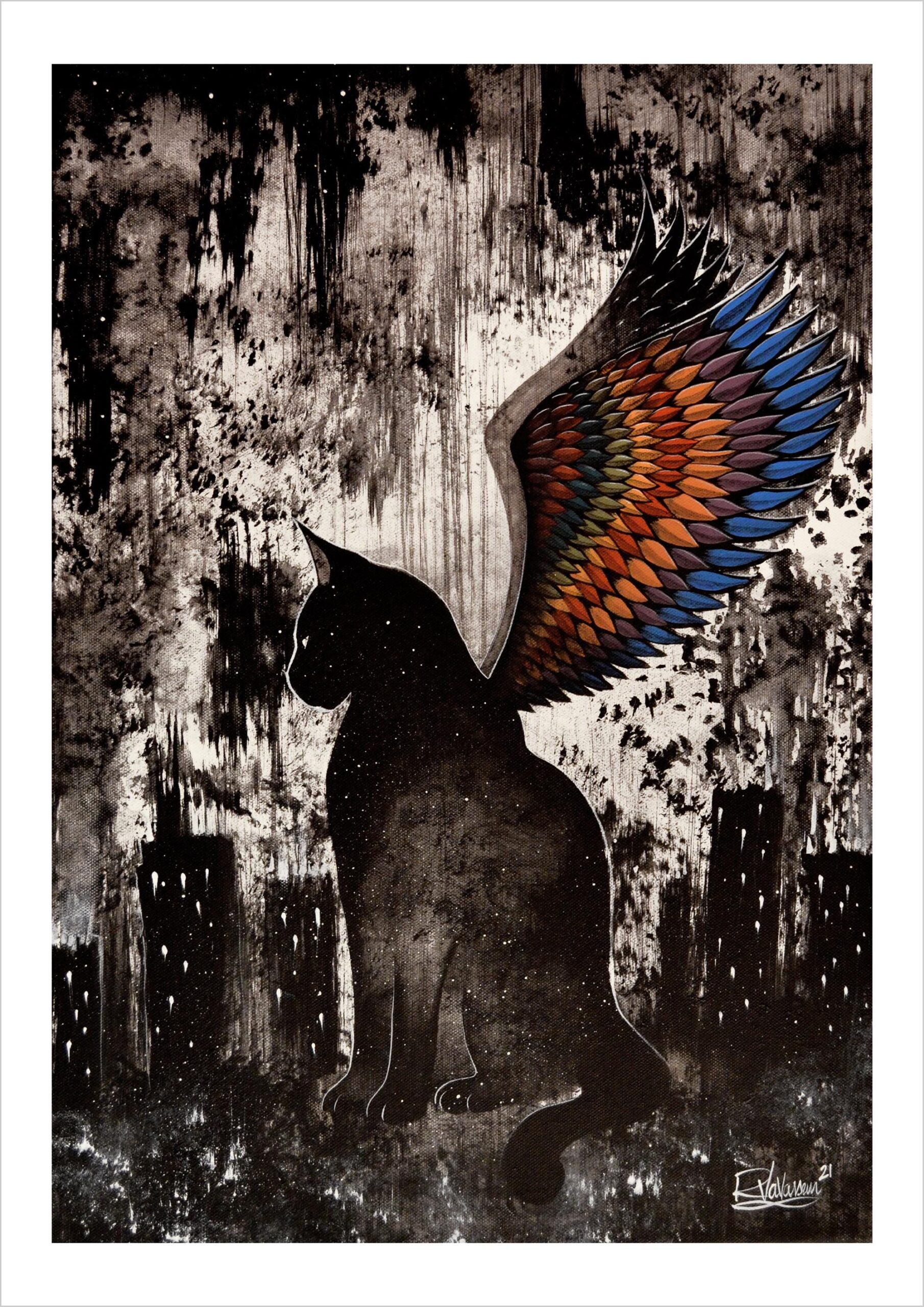
For ordinary birthdays, a medium fine art print is almost always the right scale. For milestone birthdays — thirtieth, fortieth, fiftieth, retirement — consider an original from the original cat paintings. The single, unrepeated nature of the original carries the weight the moment deserves; it is also the form least often regretted years later.
Weddings and housewarmings
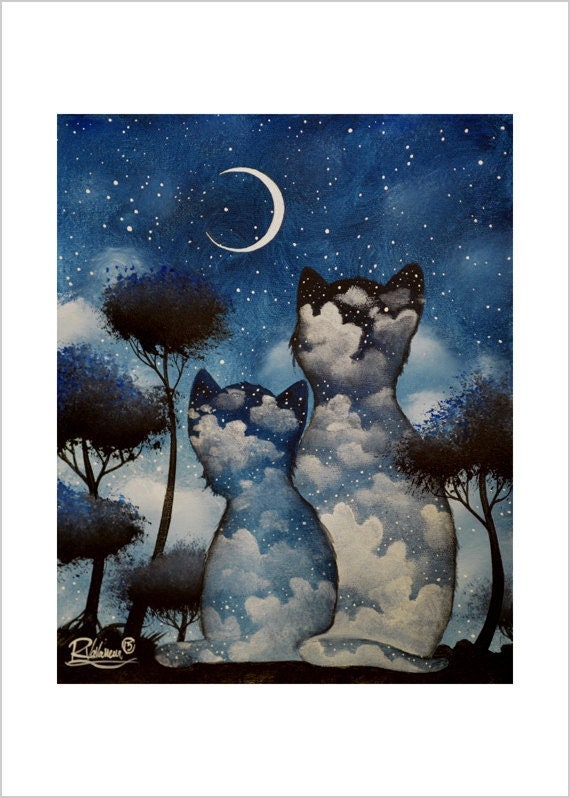
A new home asks for an image with longevity. The Black & White collection and the Moon collection are reliable choices: both flatter changing interiors over decades, neither dates quickly. Avoid choosing for the couple’s current room scheme; new homes change palettes within the first two years.
Births and christenings
The Cloud collection or Magic collection is ideal for a child’s room. Both offer feline imagery that speaks to a child without being condescending. Pieces from these collections can be bought as gifts for newborns and then re-encountered by the same child as a teenager — the imagery holds up.
Memorial gifts and grief
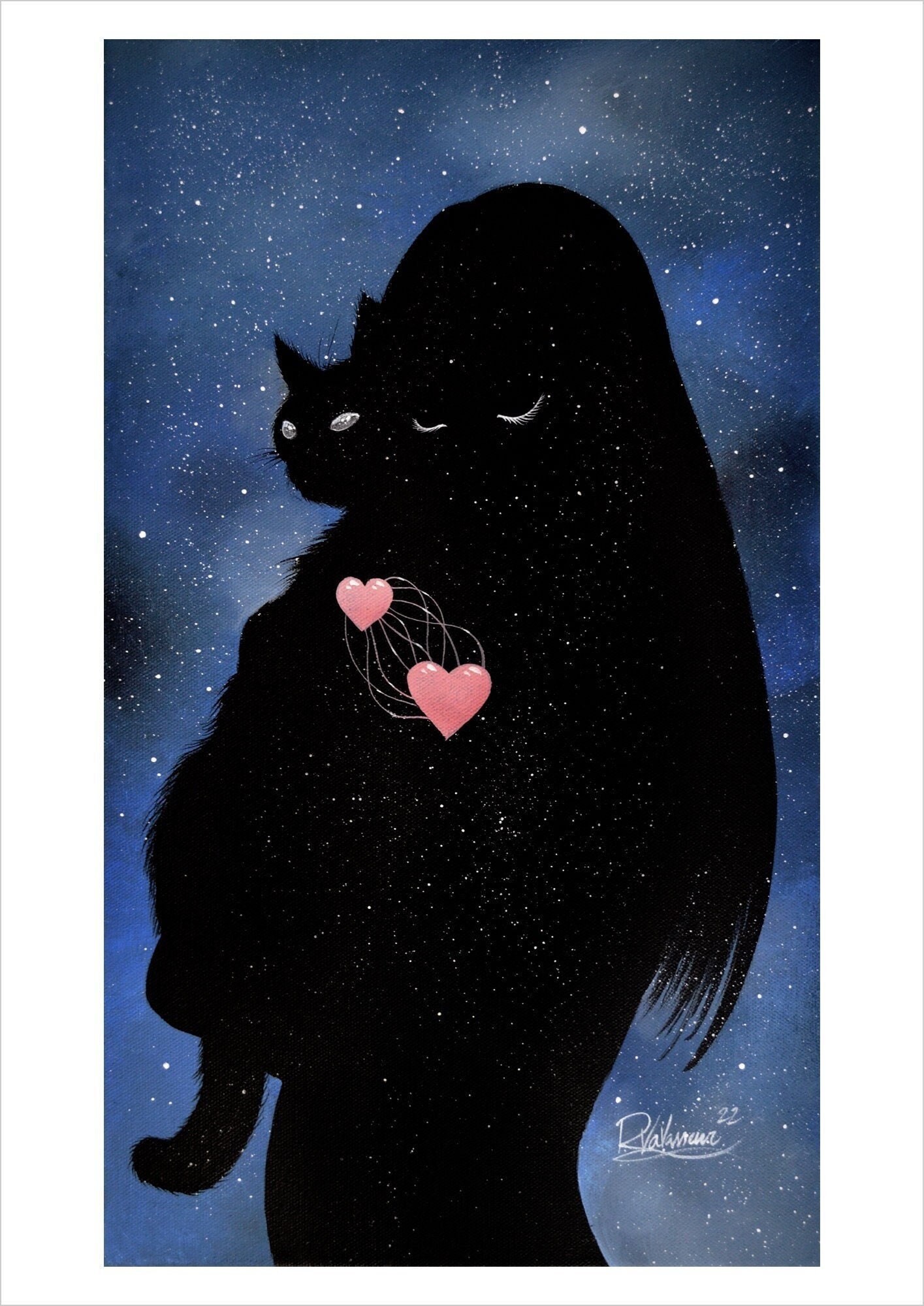
For a friend who has lost a cat or a person, a tender feline piece — the Soft collection is built for this mood — is often the kindest gift. The image does not need to refer to the lost animal; it needs only to be gentle and unhurried. Avoid commissioning a literal portrait of the lost cat; the literal approach often deepens the grief instead of easing it. A piece whose mood resembles the lost cat — a black piece for a black cat, a soft pale piece for a long-haired companion, a moonlit composition for a cat who liked the window at night — lets the recipient find the resemblance themselves, which is the gentler path.
This is one of the most recurring use-cases I hear about for my work: pieces bought as hushed memorials for a recently-passed animal, often with a handwritten inscription on the verso, given to a friend in the first weeks after the loss. The Moon and Soft collections are the most frequently chosen for this purpose; the imagery offers consolation without explanation, which is precisely what the moment asks.
Retirements and life transitions
Originals carry the weight that retirement deserves. A single signed acrylic work from the original cat paintings announces, on a wall, that a stage of life has been honoured. The recipient encounters the piece across the years that follow as a marker of the transition; few gifts perform this work as quietly and reliably.
Practicalities
Prints arrive ready to be framed in any standard mount; originals arrive ready to hang or to take to a framer. Shipping is international from France with tracking. Packaging is discreet enough to be re-wrapped without giving the gift away in transit. Most orders also include a thank-you card and, where stock allows, a second small print as a still bonus — a habit I have kept up for years.
For last-minute occasions, fine art prints can be shipped quickly; for originals, plan a little more time, as customs documentation for the canvas may add a few business days for international shipments. I answer questions about delivery windows within a day, and my Instagram channel @raphael.vavasseur.art is the simplest direct contact.
Three small kinds of failure to avoid
Three common gift errors recur, and each is easy to side-step once named.
The literal-portrait trap
Commissioning or buying a portrait designed to resemble the recipient’s actual cat is, as a rule, a kindness that misfires. The work becomes inseparable from the animal it depicts; when the animal eventually dies, the painting becomes harder rather than easier to live with. A painted cat that is not the recipient’s cat carries the affection without the freight. Choose for atmosphere, not resemblance.
The trend-piece trap
Avoid art that is recognisably of its decade. The most decorative cat illustration available online dates within two or three years; the work that survives is the work whose lineage is older than its market. The collections in my catalogue descend from Foujita and Steinlen — the Black & White, Moon, and Paris in particular — and so they carry that long lineage; they age well exactly because they were never new. I write about that ancestry in my short history of cat painters.
The framing afterthought
A fine print framed badly is a fine print diminished. If you can include a recommendation about framing with the gift — a particular framer in the recipient’s city, a specific kind of mount — the present extends into the placement and becomes more than just an object. My prints fit any standard mount, so the recipient is not constrained; but the gentle nudge toward good framing turns a print into a finished piece on the wall. Placement mathematics live in my placement guide.
If in doubt
If you do not yet know the recipient’s precise taste, the Moon collection or Black & White collection is a reliable opening move: both are universally readable, both age well, both flatter a wide range of interiors. Browse the shop and follow whichever piece keeps drawing your eye on the recipient’s behalf — in gift-buying as in collecting, the work one keeps returning to is, with rare exceptions, the work to choose.
A note on the gift card and the moment of giving
A short handwritten note that names the recipient and the occasion, without explaining the image, lets the work do its own work. Art does not need annotation; the recipient will find their own meaning in the print, and the meaning they find will be theirs. The gift card’s job is to mark the moment, not to translate the picture. A brief, warm note ages better than a long explanatory one.