
What does it mean to paint an animal small enough to hold in your arms and large enough to belong to the universe? The cosmic cat is the image that answers that recurring human wish. It is one of the most resilient figures in contemporary illustration and fine art precisely because the scaling problem — intimacy against immensity — cannot be solved with any other domestic creature. My Cosmos collection, and the closely related Magic collection, sit at the centre of a visual tradition older and stranger than most contemporary buyers realise.
Where does cosmic cat imagery come from?
The pairing is older than modern illustration by several millennia. Ancient Egypt placed cats among solar and lunar symbols: the goddess Bastet, principally feline, was associated with the protective night sky as her temple at Bubastis grew through the Late Period (664–332 BCE), and surviving bronze figurines and reliefs occasionally show her with celestial discs above the head. The Egyptian cosmology made cats partial intermediaries between the household and the heavens; their domestic familiarity and their distinct night-vision made the cat a natural figure to mediate between worlds.
Persian and Islamic art of the medieval period developed a rich astronomical iconography — the celestial atlas of al-Sûfî (964 CE) catalogued the 48 Ptolemaic constellations with extraordinary precision — but cats were not among the figures of the night sky in that tradition; the iconography stayed with the classical constellations the Greeks had bequeathed. Cats came to the constellations only much later, in 18th-century Europe, when Jérôme Lalande proposed the short-lived constellation Felis in 1799 (now defunct: the IAU 1922 list does not include it). The contemporary cosmic-cat image is in some ways a return to that brief, hopeful 18th-century gesture.
In East-Asian and European decorative traditions, on the other hand, cats and stars do meet visually — in textiles, in 19th-century children’s illustration, in astrological pop iconography — less as canonical iconography than as a visual habit that contemporary illustration has carried forward and amplified. My own work sits in this longer, looser tradition: the cosmic cat as small custodian of an immensity that is felt, not charted.
Cats and the night sky in modern Western art
Twentieth-century artists picked up the motif under different names. Léonard Foujita’s lunar cats, painted in Paris in the 1920s and 1930s, are typically lit as if by night-sky illumination even when no stars or moon explicitly appear in the composition. Théophile-Alexandre Steinlen’s shadowed silhouettes carry a similar cosmic register: the cat as small, alert silhouette under a vast dark sky.
Paul Klee — whose 1928 Cat and Bird hangs at the Museum of Modern Art in New York — produced several feline-cosmic faces in which the cat’s features are reduced to almost astronomical marks. Contemporary illustration has carried the motif into card design, tattoo work, and editorial covers. The cosmic cat thrives in any visual culture that takes both intimacy and immensity seriously, because no other small domestic animal lends itself as naturally to that scaling.
How I paint the cosmic cat
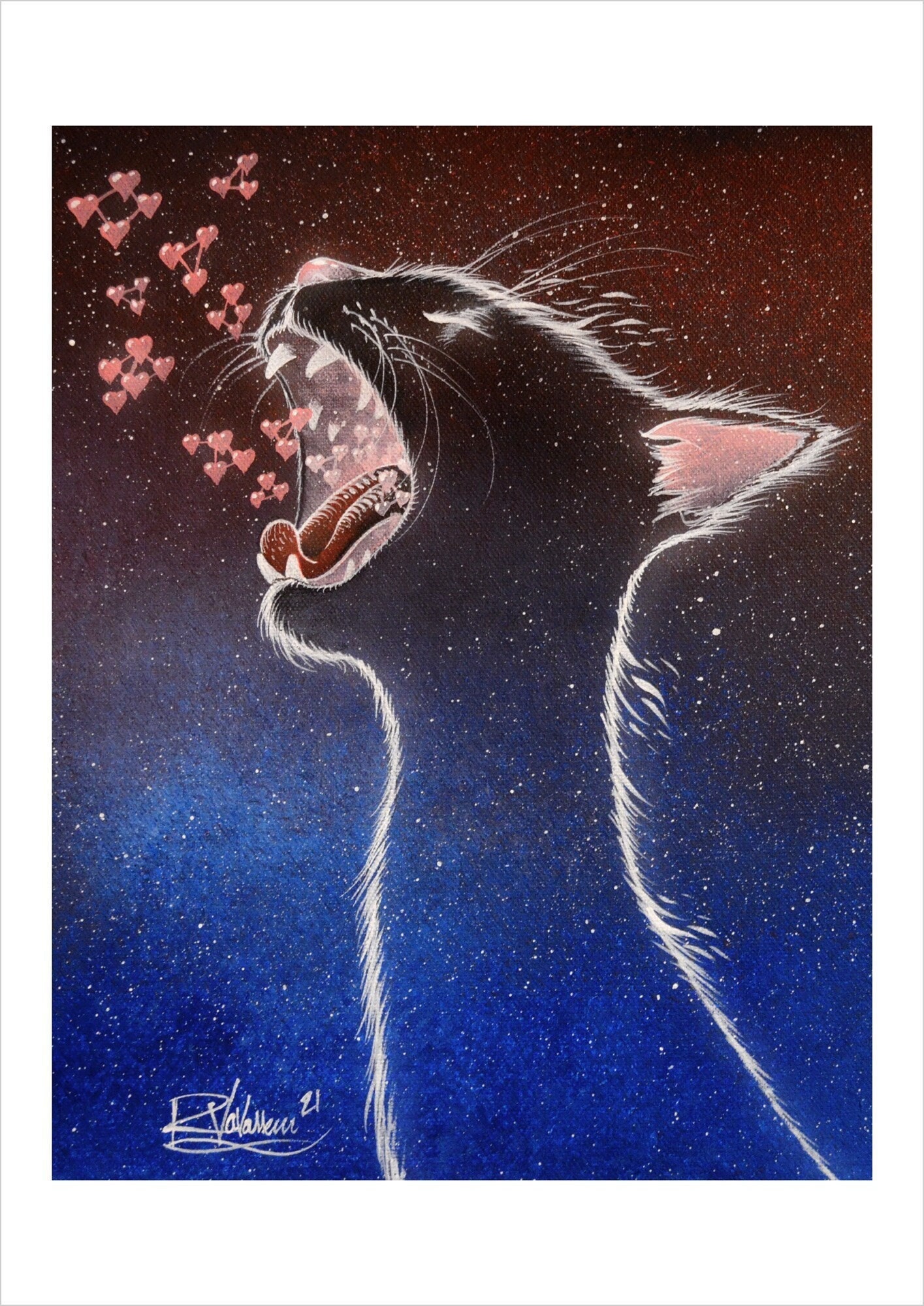
My cosmos pieces are acrylic paintings on canvas: cats placed small within deep night-blue grounds, framed by scattered suns and constellation patterns. Pieces such as The night of butterfly, Midnight cats, and Follow the butterfly exemplify the range — modest interstellar travellers under a generous sky, sometimes accompanied by the butterfly motif that recurs across the cosmic-celestial register of my work.
The originals are dense — a flat reproduction would lose the universe in the background — so I build them in many thin acrylic layers rather than a single pass, to keep the depth of the night, the soft warmth of distant light, and the slightly hand-made quality of the underdrawing. I describe that process in my acrylic-process note. The collection rewards extended viewing in a way most decorative cosmic imagery does not.
Cosmos vs Magic: how I think about the line between them
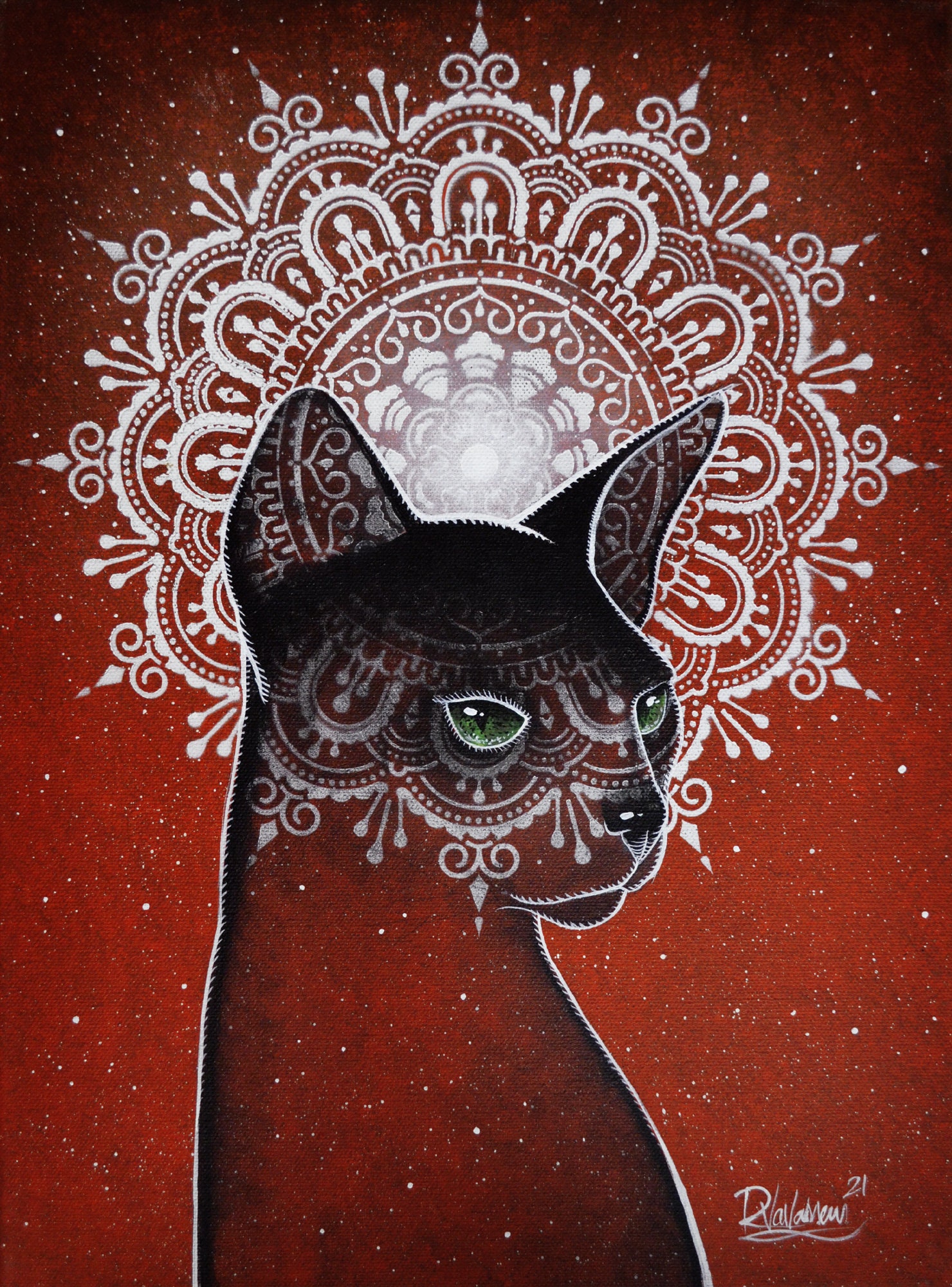
The Cosmos collection stays explicitly astronomical: stars, constellations, planets, comets, the literal furniture of the night sky. The Magic collection takes the same nocturnal palette but adds occult or folkloric signs — sigils, hidden plants, ribbons, ritual objects — pulling the imagery toward folklore and compact private mythologies. Many collectors own pieces from both because they share a tonal family but answer different appetites: the Cosmos pieces sit closer to astronomy, the Magic pieces closer to alchemy.
Both collections also belong to the wider nocturnal core of my studio — the Moon collection and the deeper end of the Black & White collection share their tonal grammar — and many household walls work best when a piece from one of these after-dark collections anchors the room.
Where to display cosmic cat art
Studies, libraries, bedrooms in nocturnal palettes, and any room you use mostly after dark. The Cosmos pieces suit walls beside reading chairs and bedside tables; the Magic pieces reward spaces with low warm light, like reading nooks or attic studios. Avoid placing the more atmospheric, deep-blue pieces in rooms with strong daylight on the wall — the depth disappears under direct illumination.
Frame the cosmos prints tightly, with a wide white mount; the breathing space gives the night-sky imagery room to expand. Avoid heavy ornate frames; they compete with the cosmic tonal family and tend to flatten it. The placement mathematics — sightline, scale, hardware — live in my placement guide.
Three motifs that recur in my Cosmos collection
Three compositions appear with particular frequency in the Cosmos pieces and deserve their own attention, because each takes the cosmic cat in a slightly different direction and each rewards a different kind of room.
The constellation-cat
In several of the strongest pieces in the collection, the cat itself becomes part of the constellation — its body the shape that the stars seem to be tracing, gold dots placed along the spine, the tail, the ears. The composition is borrowed, knowingly, from antique star-atlas illustrations, in which the constellation figure was drawn over the actual star pattern. My variation places the contemporary cat as inheritor of that quietly defunct tradition — an echo of Lalande’s lost 1799 Felis on the wall.
The night-traveller
A slight cat walking across an empty foreground while the vast night sky takes up most of the canvas. The image owes its compositional logic to the late-Romantic landscape tradition (Caspar David Friedrich’s diminutive human figures against immense natural scenes) but transposes the human to feline. The result is gentler than Friedrich’s and more indoor, but the underlying scale-of-immensity is intact. These pieces work particularly well above reading chairs and beside libraries, where the viewer’s scale and the cat’s scale align softly.
The constellation-letter
A single sleeping or sitting cat with a constellation drawn directly above its head, as if the night sky were dropping into the cat’s mind. This is the most explicitly symbolic of the cosmos motifs and the closest to the magic mood; it sits at the boundary between the two collections, and is often the pivot piece for collectors deciding between the Cosmos and the Magic collection.
The cosmic cat in literature and adjacent traditions
The painted tradition has parallels in literature that the cat-loving reader will recognise. T.S. Eliot’s Old Possum’s Book of Practical Cats (1939) treats cats with an almost theological seriousness, granting them three names — the public, the private, and a third name “the ineffable, effable, effanineffable / Deep and inscrutable singular Name” which belongs to the cat alone. That ineffable name sits, in Eliot’s phrasing, very close to the territory the cosmic cat painting occupies: that which is known but cannot be said.
Doris Lessing’s Particularly Cats (1967) and Colette’s feline writings of the early twentieth century carry the idiom further into prose. The cosmic cat is therefore not only a painted figure; it is the visual representative of a literary instinct several centuries old, in which the cat figures as the narrow custodian of meanings just out of reach of human language.
The cosmic cat as gift
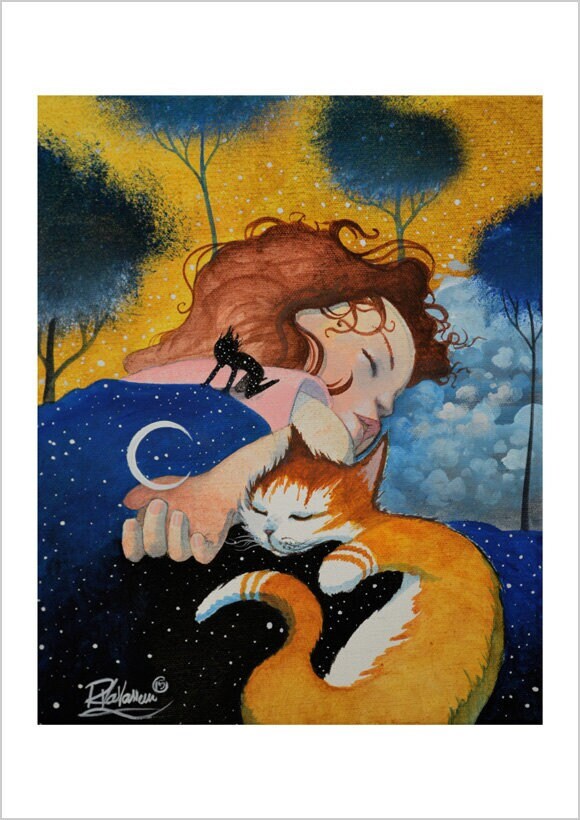
Cosmos and Magic pieces land especially well as gifts for thoughtful, reflective recipients — writers, readers, scientists, anyone whose interior life takes precedence over their interior décor. The imagery rewards their kind of attention. For a recipient whose taste runs toward minimalist or extroverted graphic work, the Black & White collection or Digital collection is more reliable; for an introvert who keeps a reading lamp on past midnight, the Cosmos is almost always right. I have written more about gift choices in my gift guide.
Available formats
The cosmos works are offered as fine art prints in multiple sizes, sent flat between protective boards, dispatched from France with tracking to over forty countries. Originals — one-of-a-kind acrylic paintings on stretched canvas, signed and certified — appear in the original cat paintings when available and tend to leave the studio quickly. For the full studio catalogue, browse the fine art cat print catalogue, or visit the shop which consolidates all formats and collections. New pieces typically appear first on my Instagram channel @raphael.vavasseur.art, which is also the simplest way to ask about commissions in the cosmos tonal climate.