Most cat art available online is produced digitally and printed in editions. My work, by contrast, originates as physical acrylic paintings, made by hand in my studio in France, signed individually, and only then translated into prints when I choose an original for the wider catalogue. The note below describes how I actually make these paintings — the medium, the process, the studio, the materials — for collectors who care what they are buying. Provenance is not a marketing term; it is a fact about the surface on your wall.
Why acrylic, and not oil or watercolour
Acrylic occupies a useful middle position. It can be diluted to the transparency of watercolour and layered to the opacity of oil; it dries fast enough to allow successive glazes within a single afternoon; and once dry, it is dimensionally stable for decades, with no yellowing of medium that affects oils over time. For a painter who builds an image in successive glazes rather than in a single pass — which is how I work — acrylic gives the freedom of both watercolour and oil without committing to either.
The medium has only existed in its modern form since the late 1940s. Magna paints, developed by Leonard Bocour and Sam Golden in 1947, were the first mineral-spirit acrylics commercially available; water-based acrylics arrived in the 1950s and were rapidly adopted by Helen Frankenthaler, Mark Rothko (in his later career), and Roy Lichtenstein. By the 1980s acrylic had become the dominant medium for contemporary painters who wanted layered colour without the drying times of oil. It is also more reversible during the working phase than oil — a wrong passage can be over-painted within an hour — which suits a painter who builds compositions cumulatively — not from a single resolved sketch.
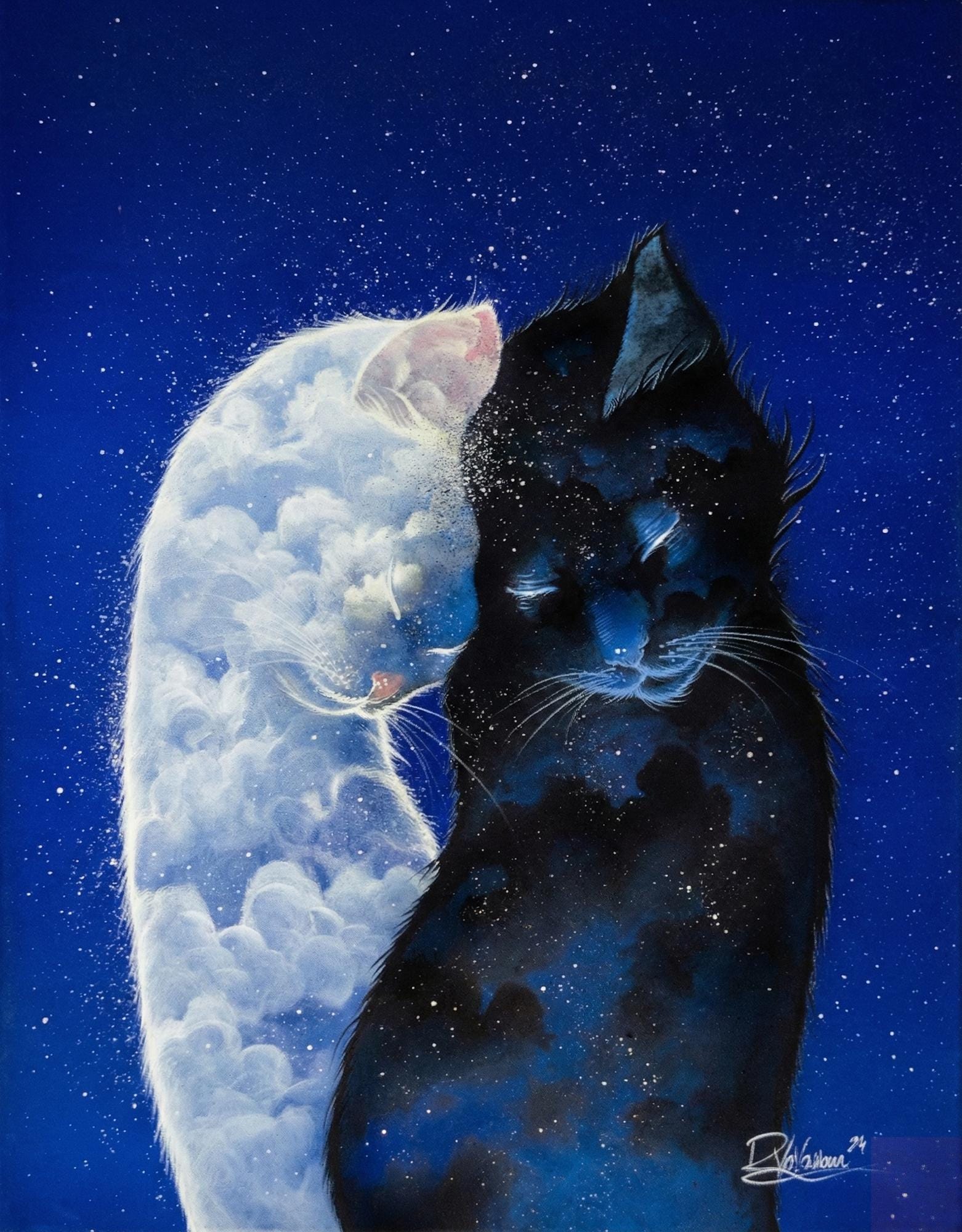
I build pieces in many thin layers instead of a few thick ones. That is why a flat photographic reproduction can mislead: the depth of my backgrounds — a starry night, an ink-wash sky, a soft pastel ground — is built up over the course of several working sessions, and only partly visible in any single photograph. The originals reward direct viewing in a way few photographic reproductions of them prepare a viewer for. The comparison between originals and prints, including the question of what a print preserves and what only the painting carries, is in my originals-vs-prints article.
The process, step by step
Drawing
Most works begin with a light under-sketch on primed canvas, locating the cat’s posture, the curve of the tail, the relation of figure to ground. A few works begin directly in paint, but most are drawn first. My three studio cats provide a steady reference for posture: I do not paint portraits of them, but they teach me what feline weight, balance, and idle alertness look like at very close range.
Atmosphere
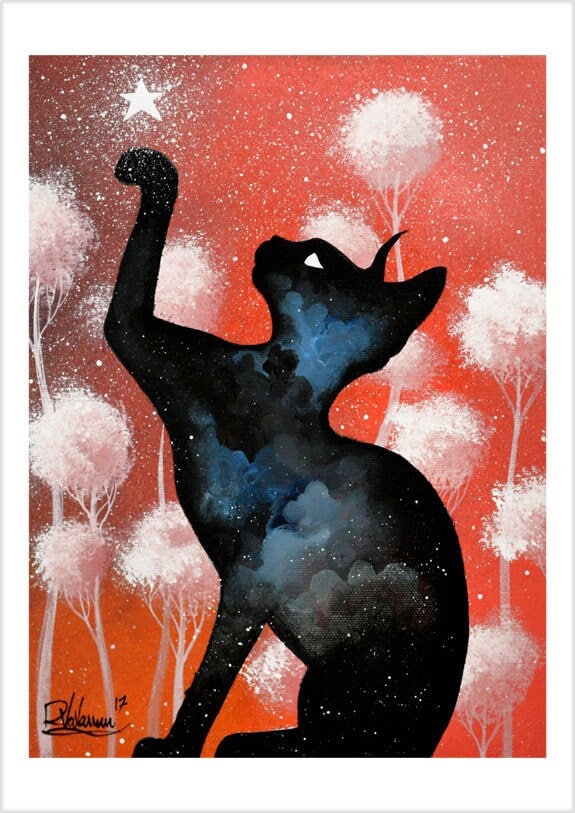
Next comes the ground — the night, the sky, the empty space behind the cat. Several thin acrylic layers are washed across the canvas and allowed to dry between coats. This is the slowest and quietest stage of the work. In the Moon and Cosmos pieces, the atmosphere often takes longer to build than the figure itself, because the depth of the night sky has to be modulated rather than declared.
Figure
The cat is then painted onto the ground, again in successive layers — not a single pass. Fur, weight, and gaze are all built up gradually: a first pass locating the silhouette; subsequent layers establishing volumes, texture, and the small modulations of tone that give the body its presence.
Finishing
I sign the piece. A soft satin varnish is then applied to the surface — a small, durable detail that gives my canvases their quiet depth, protects the paint over decades, and keeps the work hangable in normal indoor light without glare. For originals bought as gifts, a handwritten dedication is added on the back of the canvas. Each original is accompanied by a certificate of originality. The piece is registered in the studio archive and prepared for shipping.
My materials, in plain terms
My originals are acrylic on linen-cotton canvas stretched over a wooden frame, sealed under a satin-matte protective coat. The materials are conventional in the best sense: acrylic on canvas is what most contemporary painters working in mixed-tradition modes (East-Asian ink line, European glazing, modern colour) have settled on for the same reason a violinist settles on a particular bow — the medium does what is asked of it over decades without complaint.
My palette across the eight collections is consistent instead of wide: cool whites, charcoal, sepia, deep night blues, gentle pinks and creams, soft greys, occasional warmer accents. The restraint is part of why the work feels coherent across the print catalogue: a piece from the Moon collection and a piece from the Paris collection will sit on the same wall without colour-clash, because both belong to the same restrained chromatic family.
From the original to the print
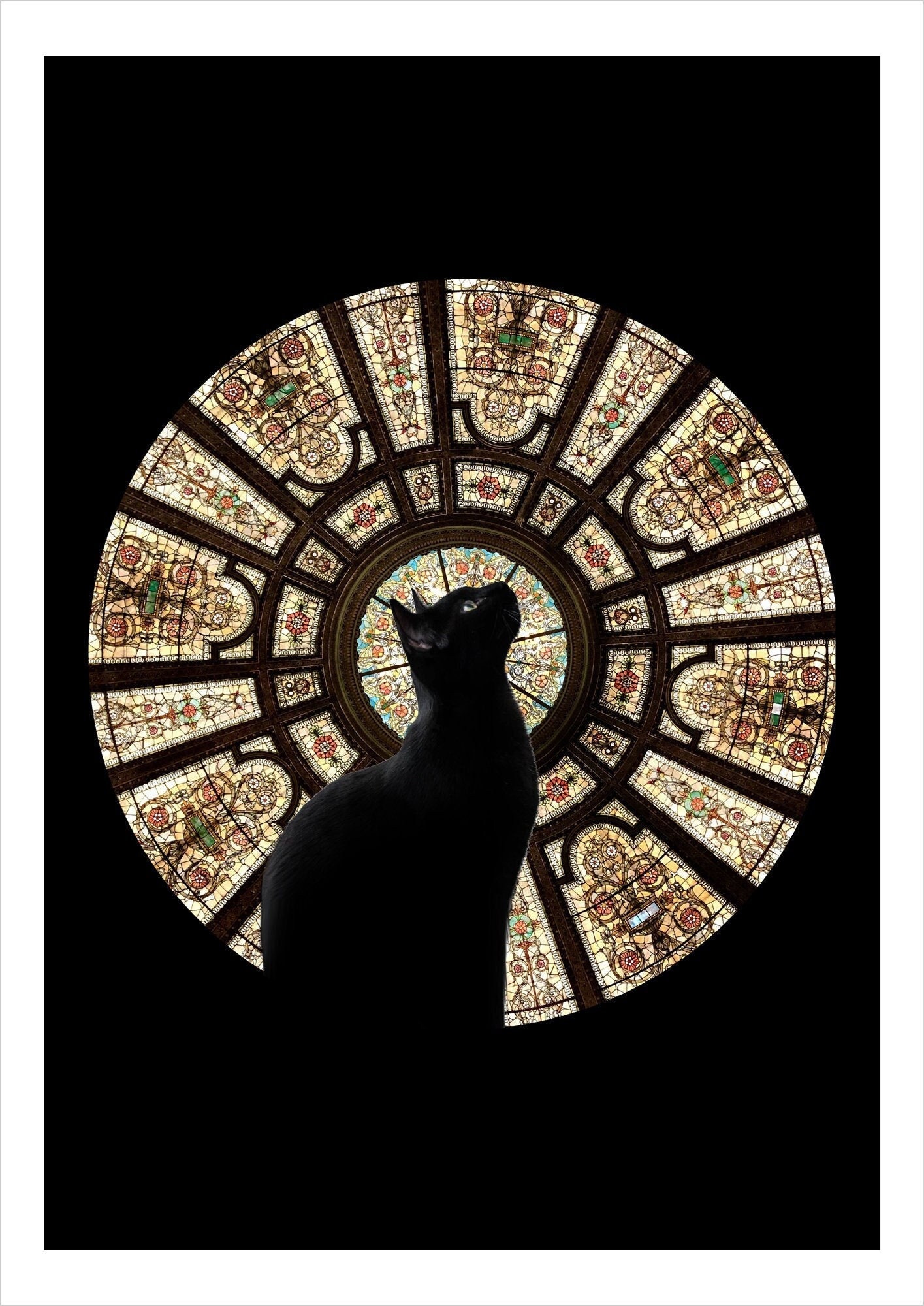
When I select an original painting for the print catalogue, it is photographed under controlled lighting and produced as a fine art print on professional photographic paper. The slight sheen of photo stock is part of why the deep tones — the night skies, the ink-wash grounds — stay legible across the print; framed behind glass, the sheen disappears and only the image remains. The reproduction process is what allows a single hand-made painting to live in many homes.
Seven of the eight collections in the fine art cat print catalogue — Black & White, Moon, Cosmos, Cloud, Soft, Magic, and Paris — are reproductions of original acrylic paintings on canvas. The eighth, the Digital collection, is a different kind of object: each piece in the Digital collection is a digital artwork made by hand by me, not generated by AI, reproduced as a fine art print in the same range of sizes as the others. The Digital collection is therefore a parallel practice rather than a translation of a physical painting — an extension of the same studio vocabulary into a different production medium.
Why hand-made origin matters
Most online cat art is produced digitally on consumer-grade printers and shipped without any indication of where the image came from. My body of work takes the opposite approach: every image in the seven painting-derived collections begins as a physical acrylic painting in my studio, then is reproduced as a print only after I have chosen the image for the wider suite. The Digital collection, separately, is hand-made digital art by me, not AI-generated, printed in the same range as the others.
What this gives the buyer is provenance. The image on the wall is not an anonymous file pulled from a stock library; it is a piece of a coherent body of work made by one painter, in one studio, across recognisable collections. Whether you buy a print or an original, the image carries its origin with it.
What it means to buy from the studio
Originals are sold once, signed on the canvas itself, accompanied by a certificate of authenticity, with the optional handwritten dedication on the verso for gifts, and dispatched from France with international tracking. The construction is acrylic on canvas under a satin-matte coat — standard throughout the original cat paintings. Prints are signed, numbered, inscribed on the verso, and orders frequently arrive with a thank-you card and a second small print as a restrained bonus — a habit I have kept through years of shipping work abroad. The canvas cat prints editions extend selected imagery onto ready-to-hang stretched canvas for collectors who prefer that surface to a framed print.
For collectors moving from the print repertoire toward an original, the path is straightforward: browse the print collections, identify the atmosphere you want to live with, then check the original cat paintings for an available work in that register. I keep an open social channel on Instagram (@raphael.vavasseur.art), where new pieces tend to appear before they are listed and where commissioned originals — a particular subject, scale, or palette — can be discussed directly. For the framing of provenance against price, see my originals-vs-prints comparison; for the history my studio sits inside, see my short history of cat painters.