Original or print? The decision is as old as printmaking itself, and yet it produces more buyer hesitation than any other in the studio’s correspondence. Originals and prints are routinely framed as competitors. They are not. They are different objects, made for different rooms, bought by different temperaments, and either format can be the right choice. I sell both from my studio in France — signed acrylic paintings on stretched canvas alongside editioned fine art prints — and the honest comparison below is meant to help you decide without pushing you in either direction.
What an original cat painting is, exactly
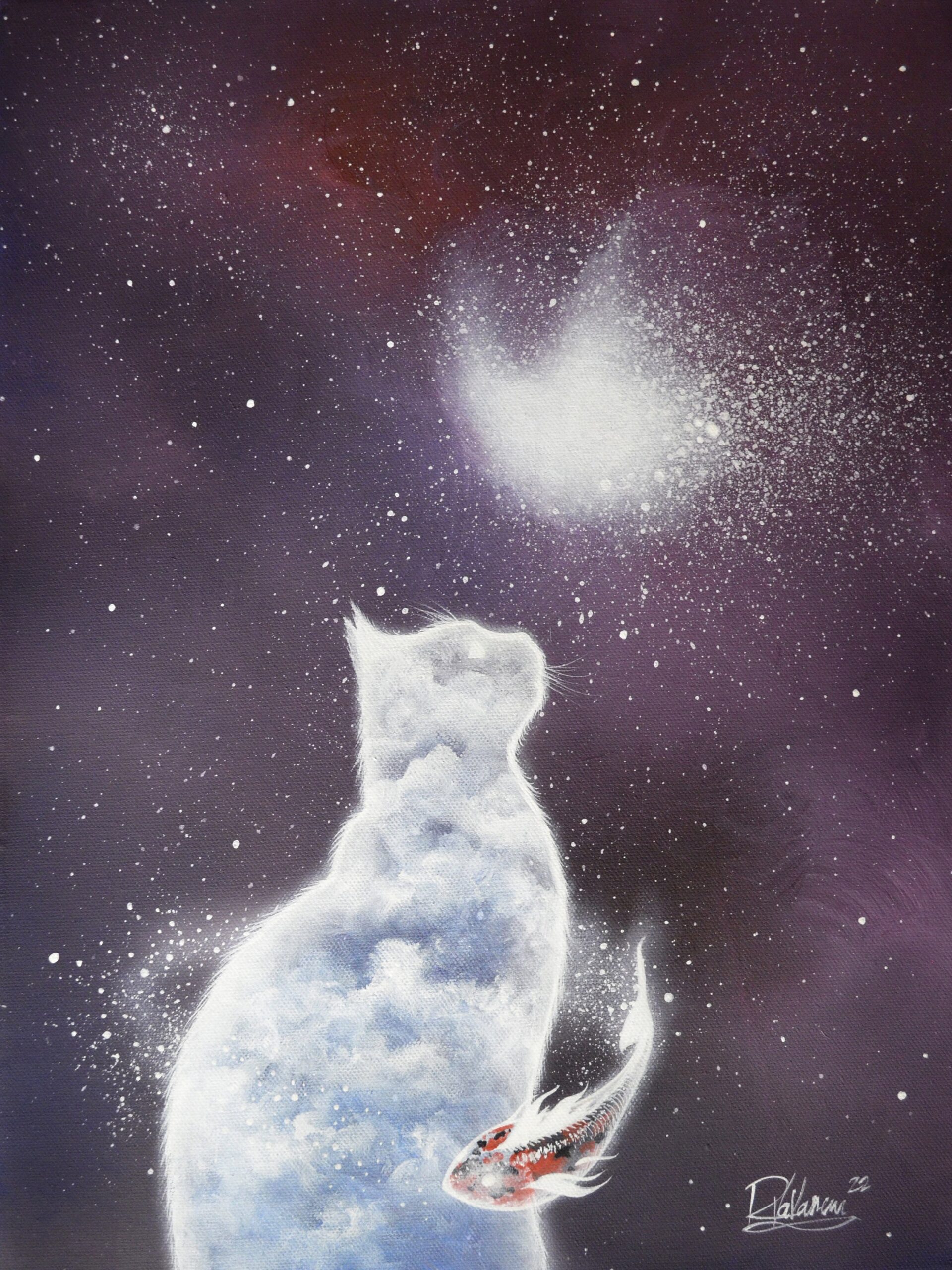
An original painting, in my catalogue, is a single unrepeated physical object — a stretched canvas on a wooden frame, worked directly in acrylic and sealed under a soft satin varnish that gives the surface its hushed depth. The piece is signed by me, certified, and may bear a handwritten dedication on the verso when bought as a gift. Once sold, the work does not exist a second time. There will be no second printing, no edition, no near-identical sibling.
Owning an original means holding the exact surface I worked on. The painting was built over several working sessions, observed at close range by my three cats who keep me company through every canvas. Brushwork is visible: the slightly trembled line of a whisker, the darker patch where a glaze pooled, the minor irregularities at the edge of a colour passage where the brush lifted. The canvas retains its breath under the protective varnish. These accidents — what Walter Benjamin, in his 1935 essay on the work of art in the age of mechanical reproduction, called the “aura” of the original work — are precisely what no reproduction can fully reproduce. Each original in my shop ships from France with tracking, and may bear an inscription on the verso when bought as a gift.
What a fine art print is, in this studio
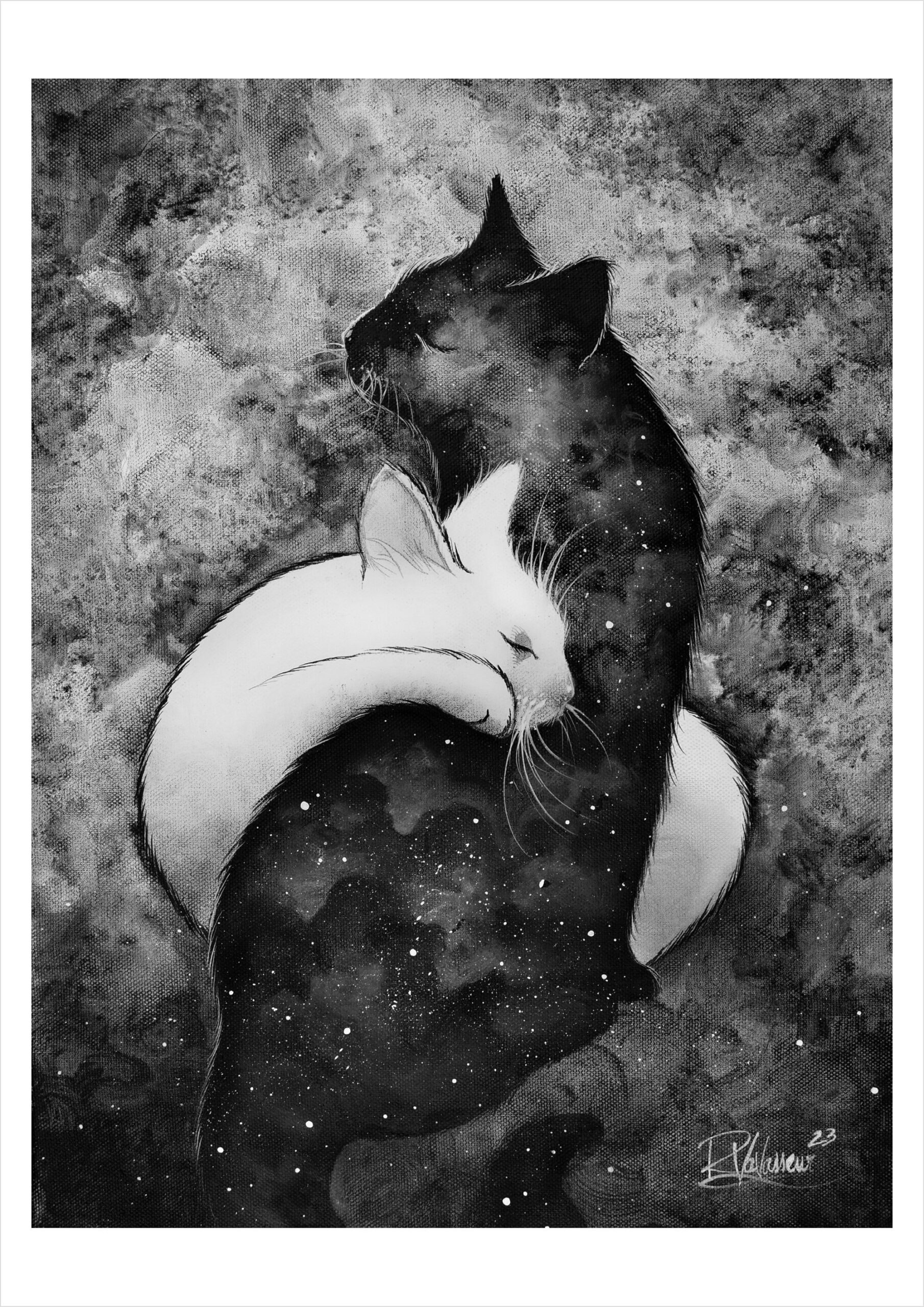
A fine art print is a high-quality reproduction of one of my originals, produced on professional photographic paper in editions across multiple sizes. The paper carries a slight sheen — the character of photo stock, which keeps the deepest tones dense — and once the print is framed under glass the sheen recedes and only the image remains. Each print is signed by me, numbered, personalised on the back, and shipped flat on a protective board so the piece arrives in immediate framing condition.
Prints have a longer history than the word “reproduction” suggests. The Japanese ukiyo-e tradition that supplied Western art with so much of its nineteenth-century vocabulary was a print tradition from its origins: Hokusai, Hiroshige, and Kuniyoshi worked closely with printmakers and sold their images as multiples. Albrecht Dürer’s engravings were collected as art in their own right in the early sixteenth century. A print is not a lesser object than a painting; it is a different one, with its own materials, methods, and presence on the wall.
My prints allow the same image to live in several homes, in several sizes, at several price points. They open my work to a wider audience without diluting it. The fine art cat print catalogue gathers eight collections — Black & White, Moon, Cosmos, Cloud, Soft, Magic, Paris, Digital — each with a distinct tonal register. The eighth (Digital) is hand-made digital work made by me, not generated by AI; I describe the medium and the process at length in my acrylic-process article.
Originals or prints: which is right for you?
Choose an original if…
…you want a single piece you will own for life, the exact surface I worked on, the small irreproducible details. Originals are also natural choices for milestone gifts, anniversaries, retirements, and rooms whose centrepiece you want to be one-of-a-kind. They suit collectors who are buying not just an image but a presence; if the phrase “I want the painting itself, not a reproduction of it” feels true to you, an original is what you want.
Choose a print if…
…you want to live with my images without committing to a unique work, or you want the same image at a specific size for a specific wall, or you want to assemble a small gallery wall from several collections at once. Prints also travel well between rooms, homes, and stages of life: a print bought for a small flat in your twenties can move with you into a larger home a decade later. The Moon collection and Black & White collection are the most popular entry points.
Can you start with prints and graduate to an original?
Many collectors do, and it is among the soundest patterns for building a personal collection. A first print teaches you which mood you actually want to live with: lunar quiet, monochrome bite, cosmic drift, Parisian light. The right original reveals itself once you know which atmosphere your eye keeps returning to. Browse the original cat paintings slowly when the time comes; the right painting usually announces itself, often after several weeks of looking. Collectors interested in commissions can reach the studio directly through my Instagram channel, @raphael.vavasseur.art, where new pieces are typically previewed before public listing.
The practical differences
Provenance and certification
Originals carry my signature on the canvas, a certificate of authenticity, and the option of an inscription on the verso for gifts. Prints are signed, numbered, and inscribed on the verso. Orders frequently arrive with a thank-you card and, when one is to hand, a second small print — an unobtrusive generosity I have kept up over years of dispatching work abroad. Both formats ship internationally from France with tracking.
Shipping and care
Originals travel in custom-cut protective packaging and arrive ready to hang or to take to a framer. Prints are packaged flat on a protective board so the piece arrives unbent, ready to be framed in any standard mount. Shipping is quick by international standards. Fine art prints last decades in normal indoor light; acrylic originals are similarly stable when displayed away from direct sunlight.
Why the work reads differently in person
I build my backgrounds in successive thin layers of acrylic over canvas. A photograph of a layered glaze tends to flatten it, because the camera resolves a single plane and the eye does not. The original therefore retains a depth the listing image only suggests. Print buyers see a softer version of the same effect: a fine art print preserves more than a photograph but less than the painting itself, which is the precise reason originals exist as a separate format and not as a replacement for prints. The acrylic process is described step by step in my process note.
Cost and budget
An original cat painting costs several times what a print of the same image costs. The difference reflects the labour invested in the single physical surface and the uniqueness of the object. For collectors building a wall over several years, this distinction matters; for collectors buying a single piece for a specific room, a high-quality print often does the necessary work.
How to evaluate a fine art print
Three qualities distinguish a fine art print worth buying from a consumer poster, and they are worth understanding before any purchase — from my studio or from anywhere else.
The first is tonal fidelity to the original. A well-produced print should match the tonal range of the painting within visible perception; a poor one will flatten the subtleties, lose the lifted highlights, and over-saturate the deeper passages. The print should read as art, not as a JPEG of art.
The second is the density of the deep tones. A print whose blacks read as grey under directed light is poorly produced; a print whose blacks hold their density under all lighting conditions is doing its job. The monochrome works in the Black & White collection are the clearest test of this quality — the depth of the black is what makes the silhouette legible from across a room.
The third is presentation on arrival. Fine art prints should ship flat, protected, and ready to be framed in any standard mount. A print delivered creased or rolled too tightly tells the buyer something about the rest of the production process.
Will an original or a print hold its value?
Originals are unrepeatable physical objects, and their secondary-market value tends to rise more reliably over a painter’s career. Prints retain their condition for decades but are not, in the strict art-market sense, unique. Most of the people who buy my work, however, are not buying for resale; they are buying to live with. Both formats reward that purpose.
Where to start your collection
If you are buying your first piece, start with the catalogue rather than the originals. Move through the fine art cat print catalogue collections in turn, note which atmosphere your eye keeps returning to, and let the right print announce itself. When the room and the image agree, the decision is straightforward. Move toward the original cat paintings when you know the idiom you want to live with; the right painting will, by then, be unmistakable. For format and scale decisions, my full guide to choosing cat art for your home covers the four questions in order. For the wider catalogue, the shop carries the full range, including the canvas cat prints editions for collectors who prefer stretched canvas to framed paper.