
Few animals carry as many simultaneous meanings as the black cat. The same silhouette that sat at the feet of Egyptian temple priests as a companion of Bastet became, a thousand years later, a folkloric suspect in medieval Europe, then, in 1896 Paris, a graphic citizen of the bohemian city. Of all the cats I paint, the black one drags the longest historical wake behind it, and the work has to absorb that wake without being weighed down by it. My Black & White collection gathers the contemporary chapter of that argument, and the essay below is the way I think about the lineage when I am at the easel.
What does a black cat symbolise in art?
Across cultures, the black cat tends to signify three things at once: protection, hidden knowledge, and the dignity of solitude. In ancient Egypt, where the goddess Bastet presided over hearth, fertility, and the safe passage of the dead, cats — including dark-coated ones — were cared for in temple precincts, mummified at death, and sometimes accompanied an owner into the tomb. The dark cat was not a portent there; it was a guardian.
Japanese tradition reads the black cat similarly. The maneki-neko figure is most often white, but black variants exist and are specifically associated with protection against ill-fortune. Edo-period woodblock artists, particularly Utagawa Kuniyoshi (1798–1861), depicted black and dark-coated cats with the same affectionate seriousness they granted samurai. In those prints, the cat is a citizen, not a portent.
European folklore took a stranger turn. From roughly the twelfth century onward, the black cat was associated, in some regional traditions, with witchcraft and bad luck. The papal bull Vox in Rama, issued by Gregory IX around 1233, denounced an alleged heretical sect that purportedly venerated a black cat, and contributed to a climate of suspicion that surfaces in later European trial records. A popular and frequently repeated narrative holds that medieval Europeans then killed cats en masse and so worsened the spread of the Black Death by removing the predators of plague-carrying rats. Modern historians have been more cautious about that causal chain: bubonic plague spreads via fleas on rats, and the demographic data on local cat populations does not strongly support the idea that an absence of cats produced the pandemic. The folkloric memory of black cats as ill-omened, however, outlasted by many centuries the conditions that produced it — and that residual atmosphere is part of what a contemporary black cat painting now has to live with on the wall.
The 19th-century rehabilitation, briefly
Two painters did most of the work of returning the black cat to European art. Édouard Manet had laid the groundwork in 1863, when a small black cat stood at the foot of the bed in Olympia: tail raised, posture alert, eyes meeting the viewer’s. Critics at the 1865 Salon found the cat scandalous, partly because they understood the symbolism — a black cat as accompaniment to an unashamed gaze. Manet had absorbed both the European folkloric tradition and the Japonisme then flooding Paris, and produced, in a single small animal, the moment when the black cat ceased to be a superstition and became, again, a subject.
Théophile-Alexandre Steinlen extended that work three decades later, in posters and lithographs that made the black cat a freestanding graphic figure. I write about Steinlen and the wider history of cat painters in more depth in my short history of cat painters; here I want to stay with what the black cat itself was doing.
Twentieth century: from Foujita to Warhol
Through the twentieth century the black cat consolidated its position as a standalone subject. Léonard Foujita, arriving in Paris from Japan in 1913, painted cats of every colour but reserved a particular reverence for the dark ones — his ink-washed grounds and fine ink-line drawings rendered the black cat as a creature both glossy and slightly translucent, a small Buddhist presence in a Western interior. Andy Warhol’s 1954 portfolio 25 Cats Name[d] Sam and One Blue Pussy included several dark cats among its company, treating them as graphic equals to the lighter members of the family. By the time B. Kliban’s 1975 book Cat brought feline imagery into mass-market visibility, the black cat had become, among artists at least, an entirely respectable subject for portraiture.
How I paint black cats in the studio today
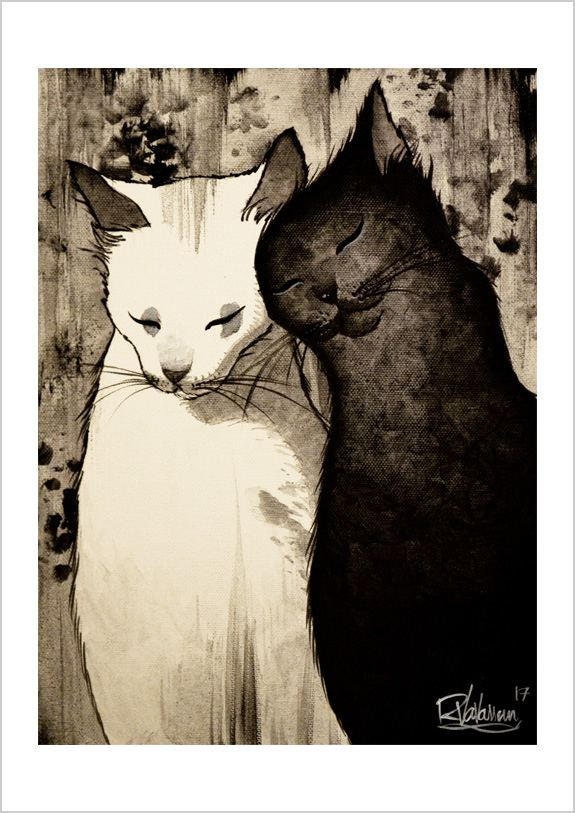
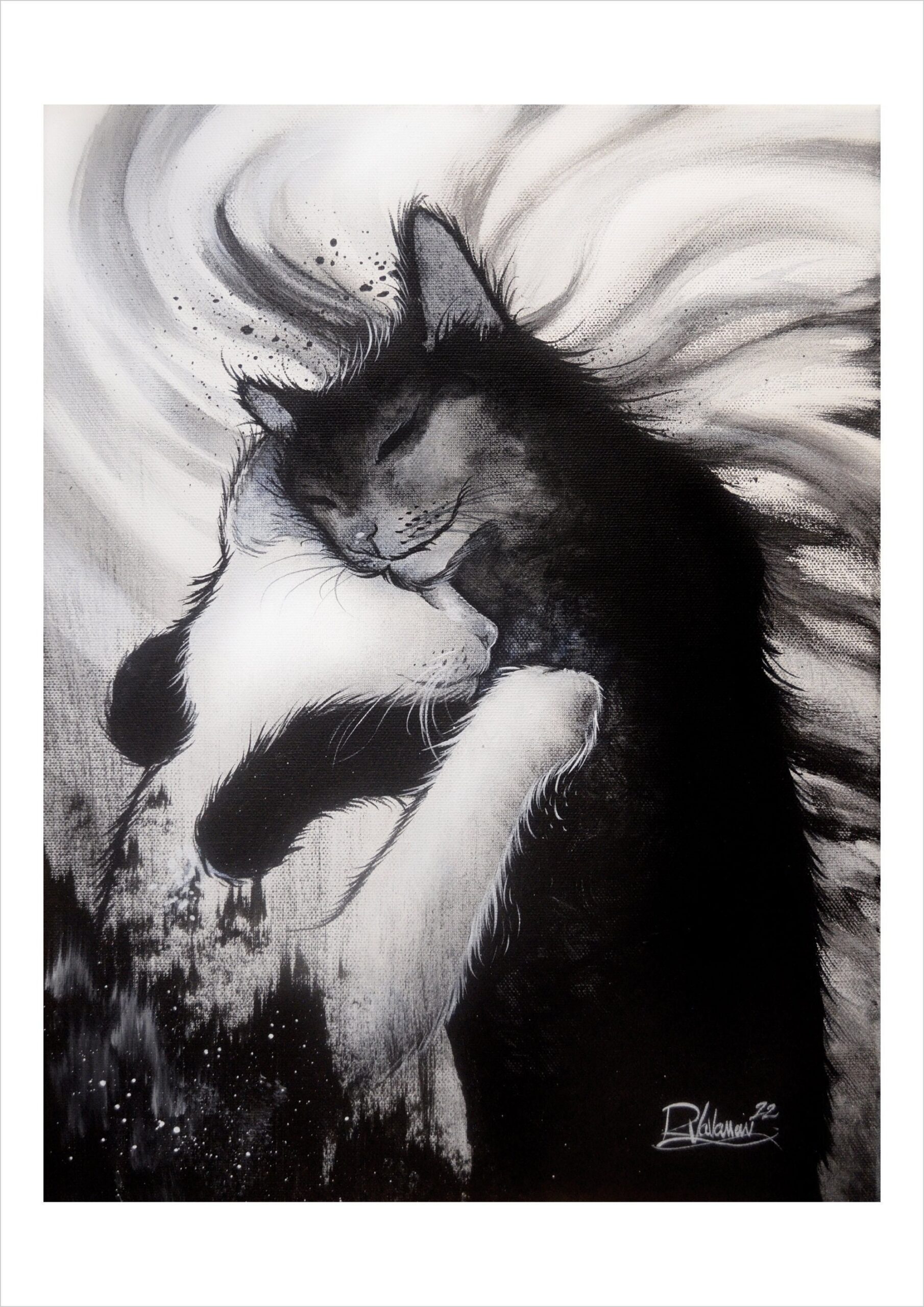
In my own work, the black cat is almost never menacing. Pieces such as The other takes care of me, Behind the cat, and The vertigo — representative titles from the Black & White collection — show the cat as companion, witness, and graphic anchor — not as folkloric portent. I work with dense ink, a pure silhouette, and a deliberate gaze.
The formal vocabulary is borrowed, knowingly, from East-Asian ink painting: economical brushwork, active negative space, posture treated as character. The emotional content is closer to European portraiture — the cat is a character, not a motif. In several of the strongest pieces, the cat is the witness to a small human grief, and its composure is precisely what gives the picture its weight. I want the viewer to feel that the cat sees what is happening and does not look away. With three cats of my own in the studio, watching me work day after day, the witness pose is something I observe at very close range.
The black cat in literature and music
The black cat’s afterlife extends past painting into the literary and musical traditions of the past two centuries. Edgar Allan Poe’s 1843 short story The Black Cat, in which a once-loved cat named Pluto returns as the figure of the narrator’s repressed guilt, remains one of the most influential dark-fiction works of the nineteenth century; it crystallised the black cat as figure of unwanted clarity. Charles Baudelaire’s Les Fleurs du Mal (1857) includes three cat poems — Le Chat I, Le Chat II, and Les Chats — in which the cat is addressed as a moral interlocutor and as an emblem of contemplative interiority. Colette wrote affectionately about cats across her career, beginning with the talking cat Kiki-la-Doucette — a grey-blue Angora — in her Dialogues de bêtes (1904). Each of these texts moved cats further from folkloric superstition and toward modern literary companionship.
The musical lineage is shorter but durable. From the 1881 Le Chat Noir cabaret (whose 1896 Steinlen poster fixed the image we now recognise) through the jazz-age Parisian chansons that name-checked black cats as small civic emblems of Montmartre, the black cat has been a figure of artistic bohemia for well over a century. The painting on a contemporary wall carries that whole ancestry in its silhouette, without requiring the viewer to know the bibliography.
Living with a black cat print
Monochrome feline prints are unusually adaptable. They sit calmly beside framed photography, pale walls, raw wood, dark frames, and changing colour schemes, because their force is structural rather than decorative. Wide white mounts heighten the calm drama of the starkest pieces; tighter framing suits the more intimate works.
The Black & White collection moves from cosmic sleep to private grief, from parody to devotion. Its quietest pieces belong in bedrooms; its most graphic ones can carry a living room or hallway. The collection sits well alongside the Moon collection and the Paris collection, with which it shares a tonal family. For room-specific placement advice, see my placement guide.
Why the black cat as image endures
A simple answer: the black cat is structurally over-determined. It carries too many meanings to ever exhaust itself. The viewer who buys a black cat print buys, simultaneously, an Egyptian guardian, a Japanese protector, a medieval folkloric suspect, a Manet provocation, a Steinlen citizen of Paris, a Foujita meditative companion, and a contemporary witness. No other domestic animal has accumulated quite that much imaginative weight. I will keep painting black cats for the same reason: the silhouette has been doing this work for over four thousand years, and it is not finished yet.
Where to find a black cat fine art print or original
The full monochrome series is offered as fine art prints in a range of sizes — each one signed, numbered, and inscribed on the verso — sent from France with tracking, packaged flat between protective boards. Browse the Black & White collection to find the piece whose temperament matches your wall, or move toward the original cat paintings if you would prefer a single signed acrylic work on stretched linen-cotton canvas, accompanied by a certificate of originality. The wider fine art cat print catalogue gathers seven further collections (Moon, Cosmos, Cloud, Soft, Magic, Paris, Digital) that share the studio’s tonal grammar without the monochrome restriction.