An original cat painting is, in the most literal sense, irreplaceable: a physical object bearing the direct, unmediated trace of a hand that moved through space and time in a way it will never move again. The surface carries brushwork, layering, indecision, and resolution — the whole archaeology of a making — in material form: the actual weight of paint, the grain of canvas, the record of a particular afternoon or evening in which decisions were being made and marks were being left. To bring an original cat painting into your home is to bring in that irreducible particularity — not only an image, but a singular painted presence.
This site functions simultaneously as gallery and text. Every painting is described here in sufficient detail that someone who cannot see the image may nonetheless encounter the work — its palette, its formal structure, its emotional tenor, the specific quality of what it holds and asks. These descriptions are composed for anyone who arrives through language rather than vision: for the visually impaired, for users of screen-readers, for whoever finds themselves reading where they cannot look. This is not accessibility as afterthought but a commitment to a principle: that the work of art, and the language that attends it, should be available to everyone who wants to engage with it.
My name is Raphaël Vavasseur. I am a French painter working in France, and for something over a decade I have been pursuing a body of work that I can only describe as an obsession — a sustained, recursive engagement with the feline figure as a site for exploring the mystical, the cosmic, and the deeply intimate registers of human experience. The paintings in my current collection are the fullest expression of that practice: acrylics on stretched canvas, hand-painted, each one existing precisely once and available to precisely one collector anywhere in the world. The obsession has not diminished. It has, if anything, grown more precise.
What Makes an Original Cat Painting Different — and Why It Matters
Every original painting holds within its surface the physical trace of a hand. Not an interpretation of that mark, not a secondary translation of it, but the mark itself: the actual deposit of pigment left by an actual person at an actual moment, on an evening that has since passed and cannot return. When you acquire an original cat painting, what you acquire is this irreducible specificity: a moment fossilised in paint, immune to repetition, incapable of existing twice.
Acrylic cat paintings occupy a particularly interesting position in the broader history of the painted image. Acrylic paint — synthetic in origin, fast-drying, capable of effects ranging from the most delicate watercolour-adjacent translucency to the most aggressive sculptural impasto — enables a painter to work with a responsiveness that oil paint, with its protracted drying times and narrower tonal range, does not easily allow. The medium accommodates sudden decisions: the palette-knife mark made in a second that alters the entire painting, the rag-drag that opens a cloud formation where none was planned, the fingertip that softens an edge to the point of dissolution. In this sense, acrylics are an unusually honest medium for the representation of cats — equally quick, equally capable of radical change, equally resistant to any single, settled reading.
The Mystical Cat in Art — A Tradition from Bastet to the Contemporary Collector
The conceptualisation of the cat as a figure that inhabits two registers simultaneously — the domestic and the numinous, the ordinary and the sacred — is not a modern invention but among the most durable motifs in the cultural history of the animal. In ancient Egypt, the cat was not merely revered but theologically significant: Bastet, protector of home, hearth, and the vulnerable, took the form of a black cat or a woman with a feline head, and to harm a cat was a capital offence under the juridical understanding of the time. The original cat paintings of that tradition — executed on papyrus, incised into tomb walls, cast into ritual objects — served not primarily aesthetic but propitiatory functions: acts of acknowledgement directed toward forces that exceeded the domestic, offerings made at the threshold between the comprehensible world and the order of powers that lay beyond it.
Across other traditions the pattern holds. Japan’s maneki-neko — the raised-paw beckoning cat — accrued centuries of spiritual valence long before its absorption into commercial iconography. In the Celtic north of Europe, cats were regularly associated with the Otherworld: they moved, in the mythological imagination, between the human settlement and the wilderness beyond it, between the ordinary order of things and the dangerous, luminous margins where the fairy folk were said to dwell. What these traditions share — Egyptian, Japanese, Celtic, and the many others that could be added to the list — is a persistent intuition that the cat’s way of being in the world is characterised by access to dimensions of experience that remain, for human beings, largely unavailable: most legible in dreams, in the late hours, in those brief and inexplicable moments of expanded perception that mystics across traditions have called, variously, illumination, grace, or simply presence.
It is this long, cross-cultural, stubbornly persistent tradition that the paintings in this collection inhabit — not as a deliberate programme or a declarative manifesto, but because a decade of sustained attention to the feline figure has made it clear that this is simply where the work wants to go. The cats I paint are not sentimentalised, not positioned within a domesticating gaze. They are animals at the outer edge of the comprehensible: liminal figures, ambassadors from a larger, stranger, more luminous order of things, momentarily patient enough to hold still while being looked at.
Inside the Collection — Original Cat Paintings
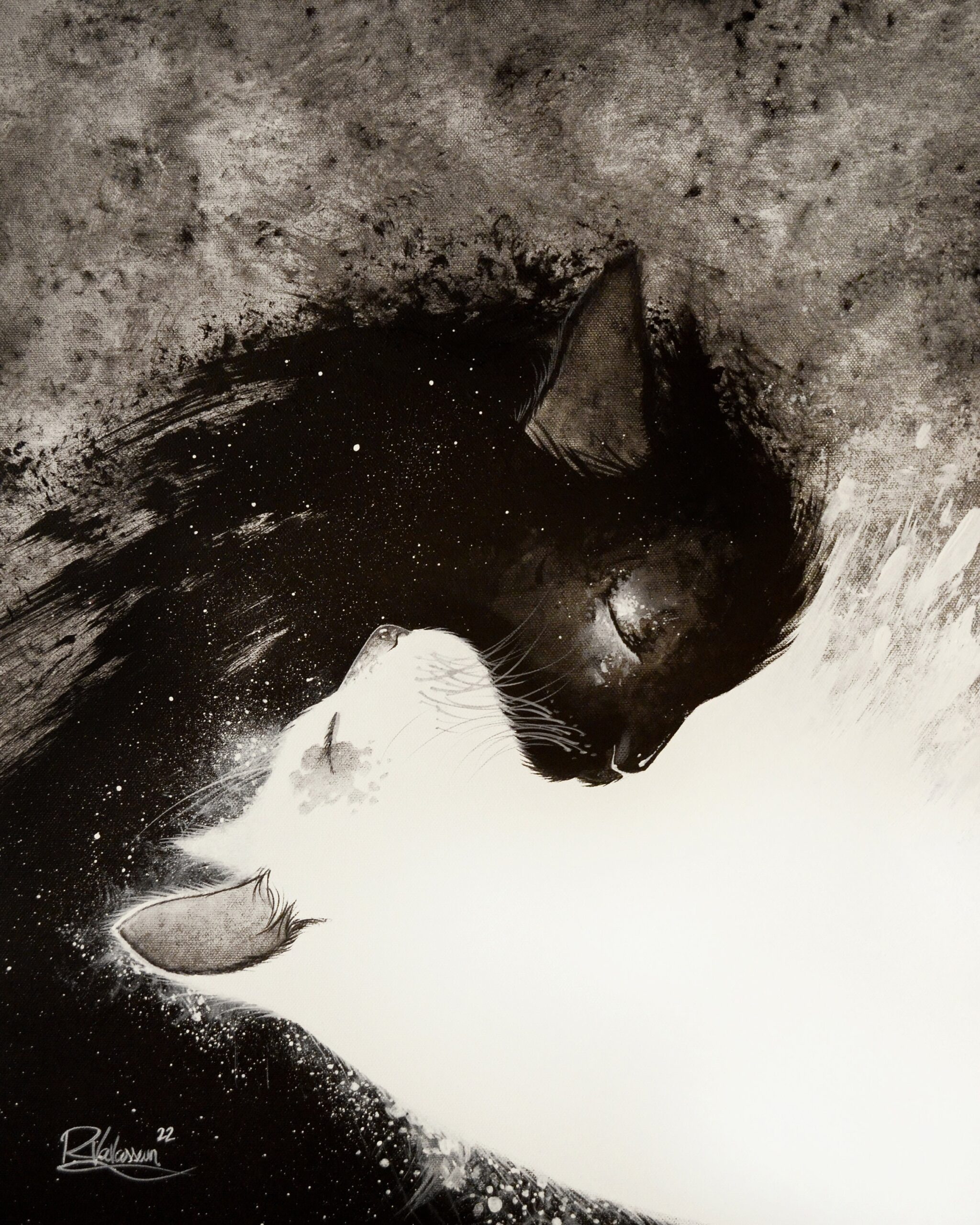
Alistar
Two cats — one constituted of shadow and scattered star-light, one of pure white — face each other in a composition that enacts, rather than merely depicts, the structural logic of yin and yang. Their profiles are opposing, their closed eyes mirroring; their muzzles approach but do not quite meet, maintaining the charged distance of a harmony that is never collapsed into unity. The dark cat carries within its body a field of tiny star-points, locating this tender confrontation within a cosmological rather than merely domestic space. What the painting finally describes is not duality as opposition but duality as completion: two natures that require each other in order to exist. Keywords: yin yang cat painting, black and white cats artwork, original feline duo painting, monochrome cat pair canvas, acrylic cat harmony art.
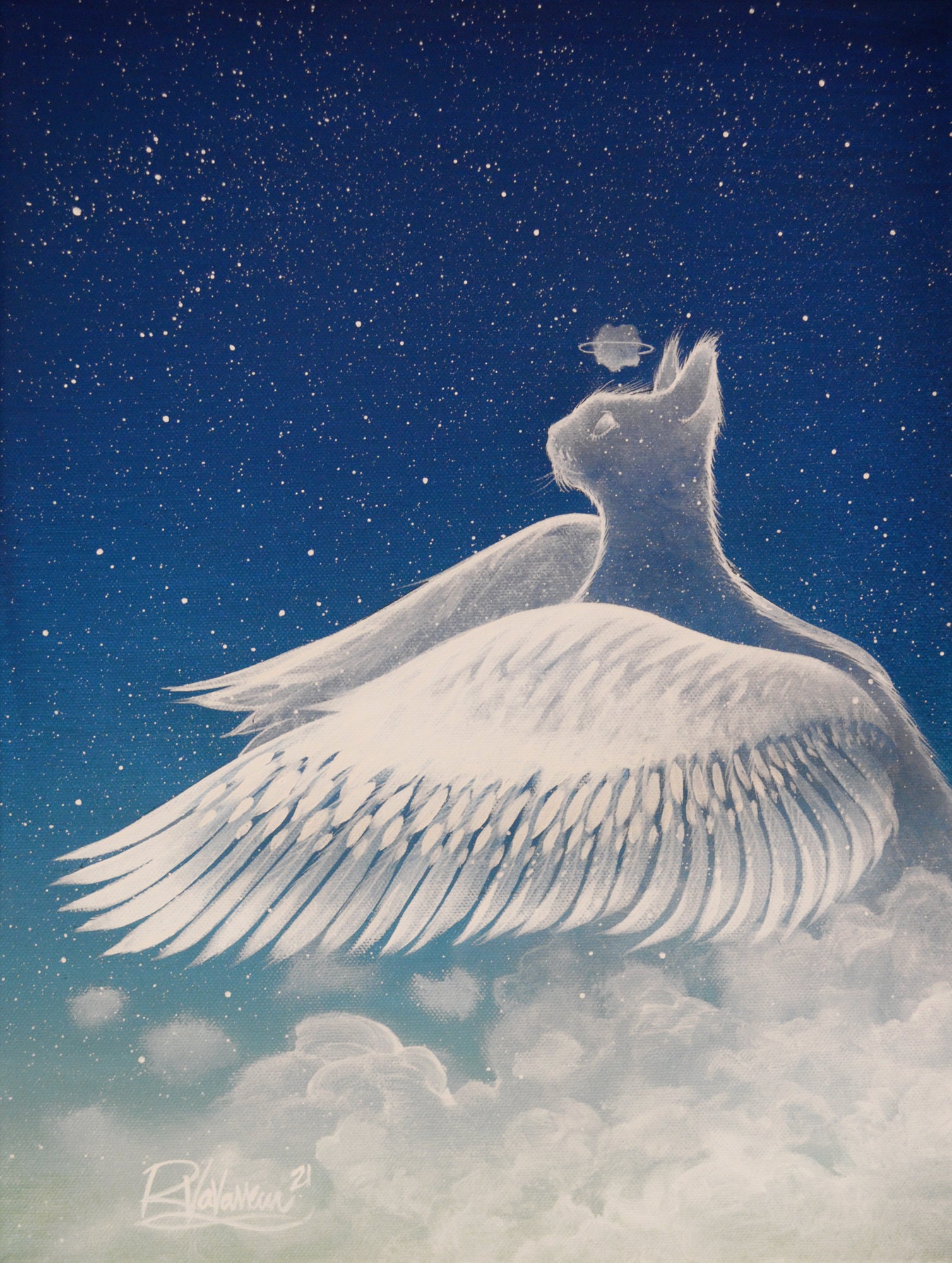
Angel Cat
A white figure — at once feline and aerial, its body composed of cumulus matter and radiant light — spreads enormous wings across a cobalt sky dense with stars. Each feather has been rendered with exacting care, the precision of their construction existing in productive tension with the cloud-like insubstantiality of the body they carry. Above the cat’s head, a ringed planet hangs in the firmament: the suggestion of a cosmos extending infinitely beyond the frame. This is the celestial guardian as painting has long imagined such beings — weightless, sovereign, entirely at ease at the threshold between the earthly and the astronomical. Themes: transcendence, celestial guardian, cosmic feline art, winged cat painting, cloud cat original acrylic, blue sky, spiritual animal art.
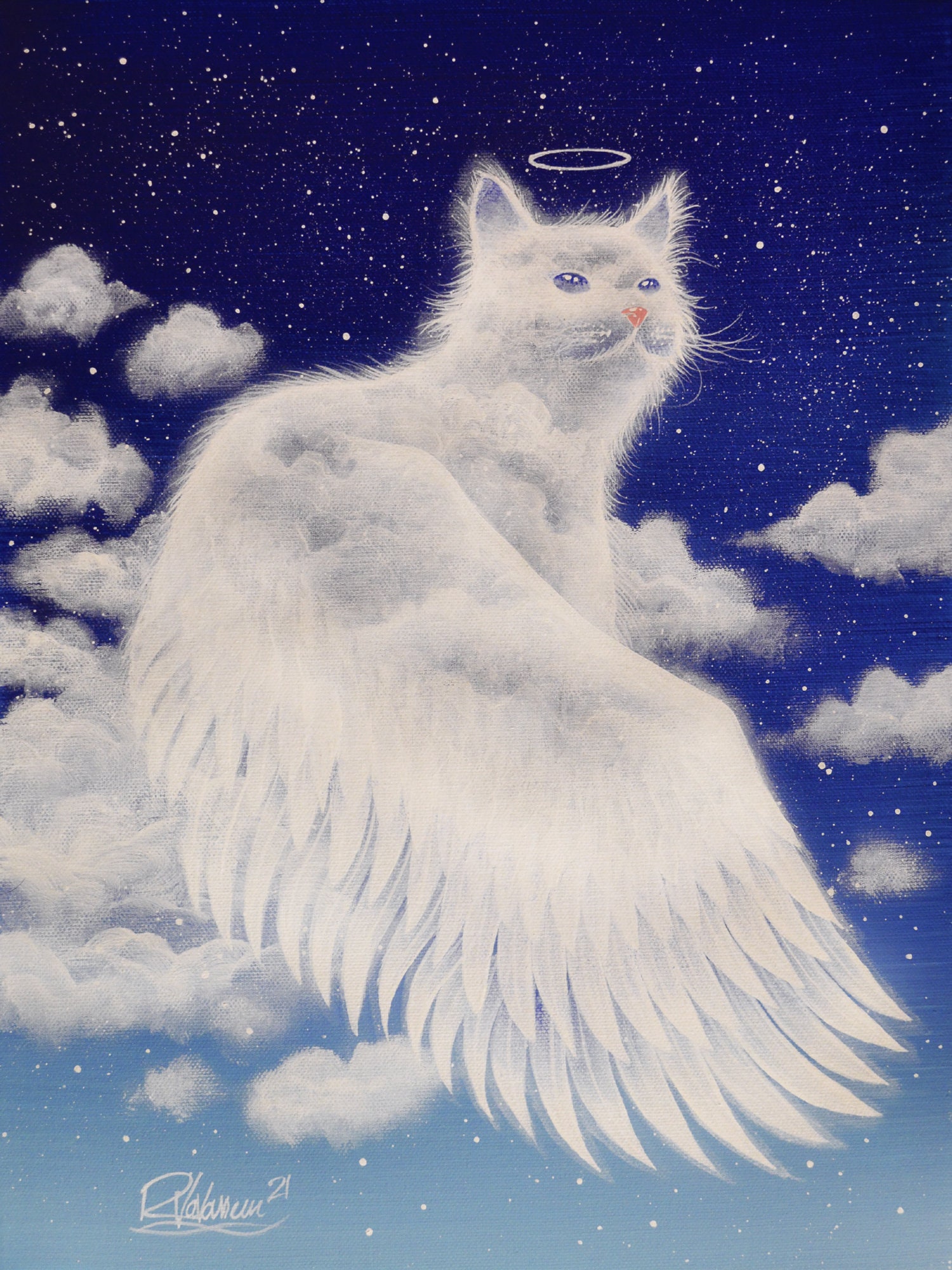
Angeloo
A white cat sits upon a cloud bank wearing a golden halo with the composure of a figure accustomed to sanctity, its wide wings opening against a night sky seeded with stars. What makes the composition remarkable is its deliberate refusal of boundary: body, wings, and cloud merge into a single incandescent mass, so that it is impossible to say precisely where the animal ends and the celestial begins. The halo marks divinity without asserting it; the calm, outward gaze belongs equally to creature and to guardian. Original mystical cat painting, celestial cat artwork, cat angel art, white cat acrylic painting, heavenly feline, halo cat original.
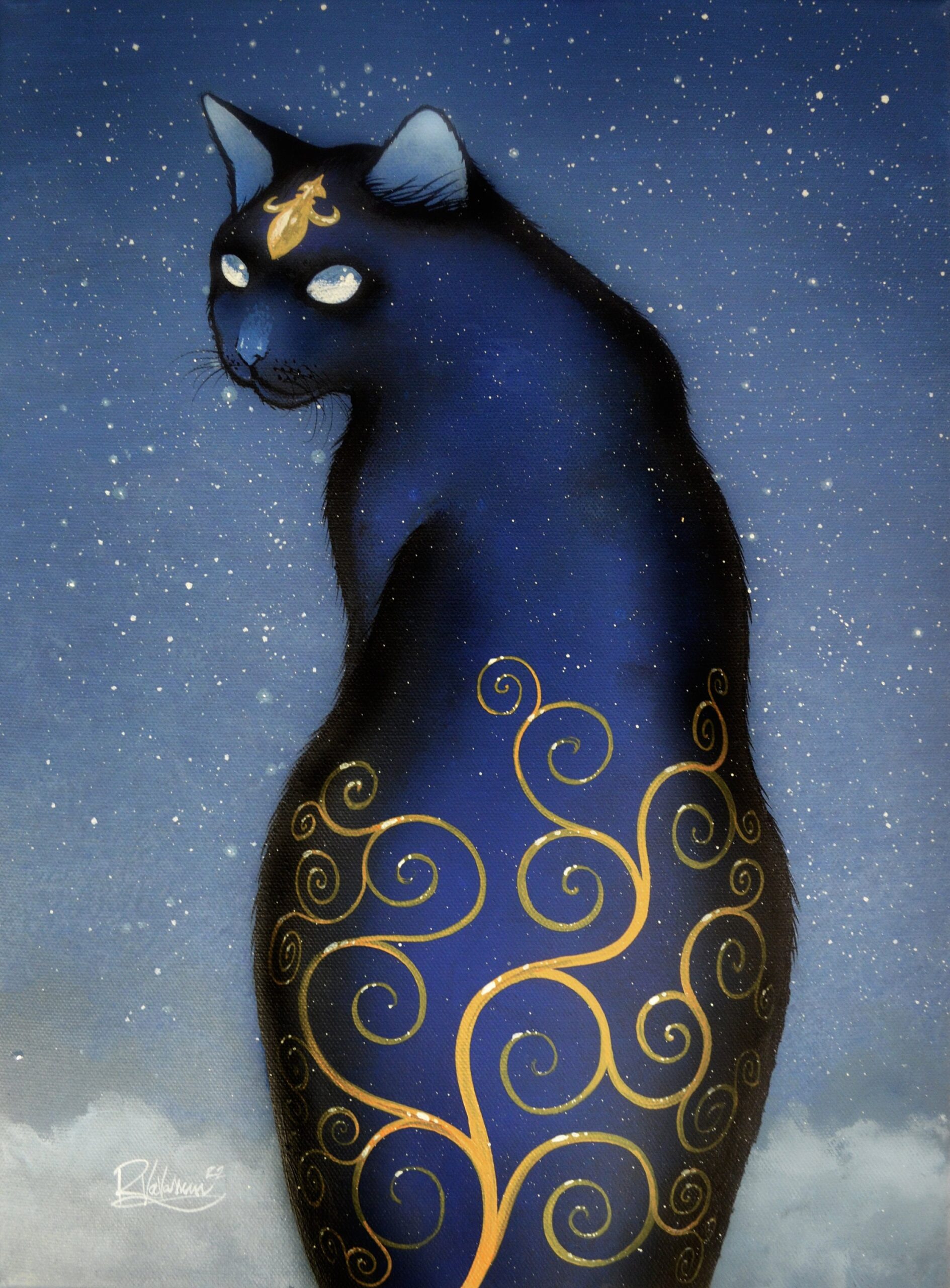
Atlantis Cat
A black cat rendered in the full decorative ambition of Klimt’s late manner: the body articulated not through naturalistic fur but through flowing gold spirals, arabesque scrollwork, and curvilinear motifs that cascade from throat to tail in disciplined profusion. A golden emblem is set into the forehead like an amulet; the eyes emit an amber-green luminosity that asserts itself against the deep indigo of a star-dense background. The painting works in the overlap between Egyptian heraldry and Art Nouveau ornament, constructing a figure that is simultaneously animal, icon, and sovereign — opulent in surface, absolute in bearing. Gold cat art, Klimt cat painting, ornamental feline original, celestial black cat, luxury cat acrylic, Art Nouveau cat hand-painted original.
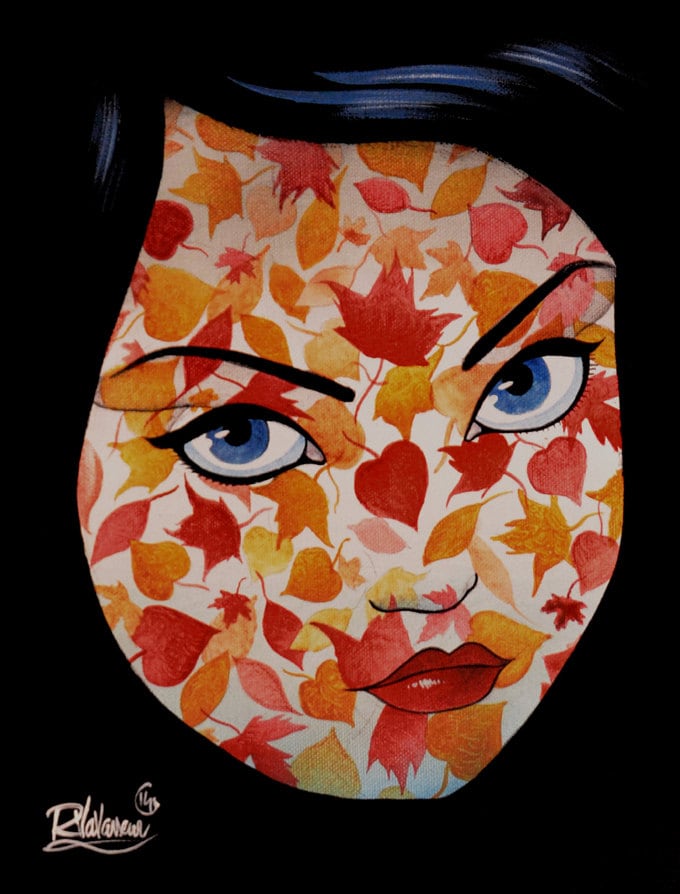
Autumn Eyes
A face assembled entirely from autumn leaves — maple, oak, and elm in scarlet, burnt orange, saffron yellow, and deep umber — from which two piercing blue eyes emerge with uncanny directness: the work operates in the distinctively surrealist mode of identity-as-landscape, where the self is not placed against a natural setting but constituted from it. The face is the season, and the season has eyes. What the painting asks, quietly and with great formal intelligence, is where the person ends and the world they have absorbed begins. Surrealist figurative painting, autumn leaf art, seasonal portrait, blue eyes painting, nature-inspired original artwork, surrealist acrylic unique canvas.
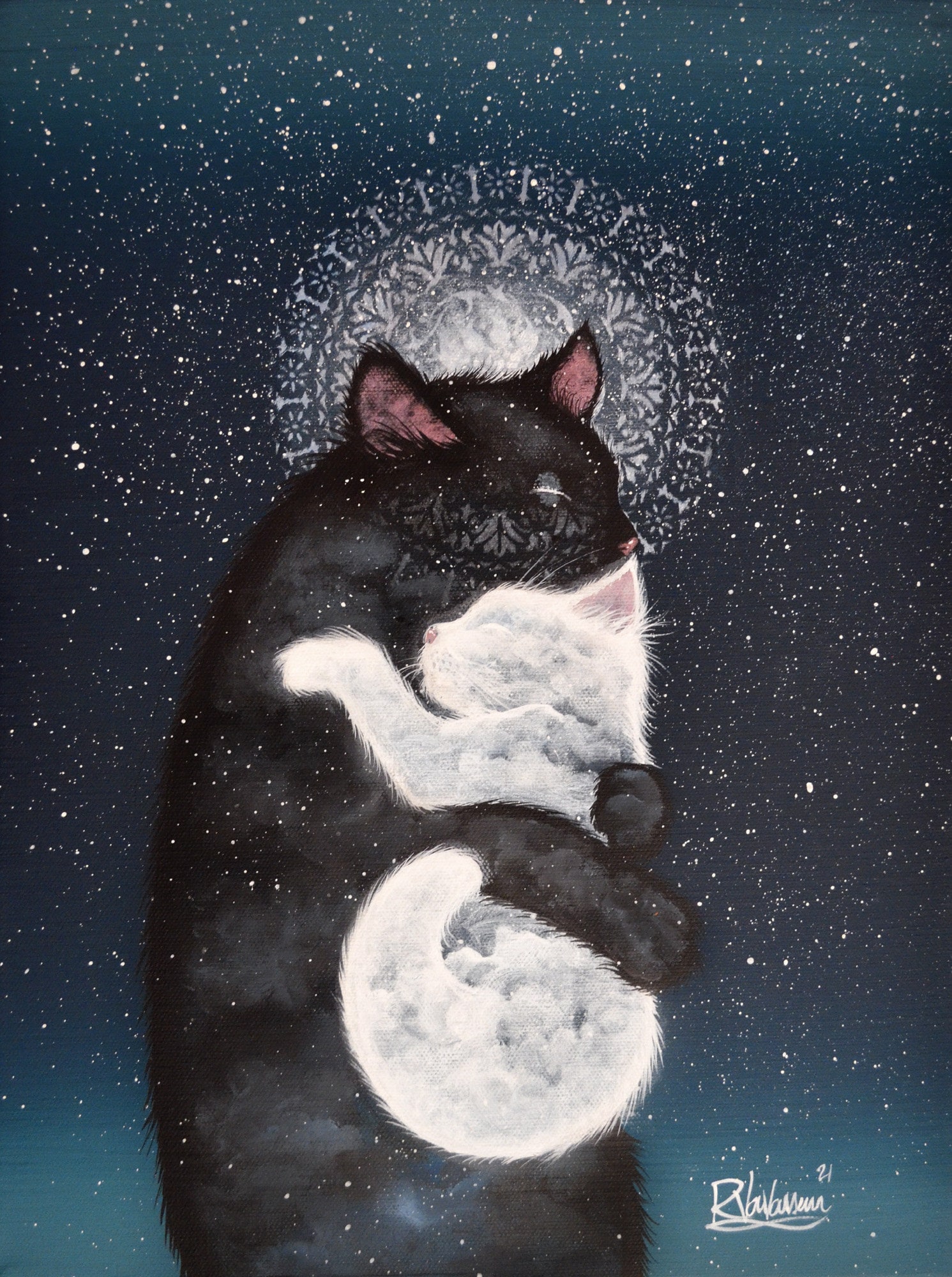
Baboo
A tuxedo cat draws a tiny white kitten against its chest with both forelegs in a gesture that is simultaneously physical and ceremonial — parental protection rendered at its most unequivocal. Behind the pair, a mandala-like halo of fine white ornamentation emanates against a deep teal-blue starry ground, framing the act of holding as something sacred, as if the cosmos itself had organised around the event of this small kept thing. The painting understands tenderness as a form of power: the protector’s authority expressed not through force but through the simplicity of an encircling arm. Original cat painting, tuxedo cat art, cat and kitten acrylic, mandala halo cat painting, parental love cat original, celestial feline one-of-a-kind work.
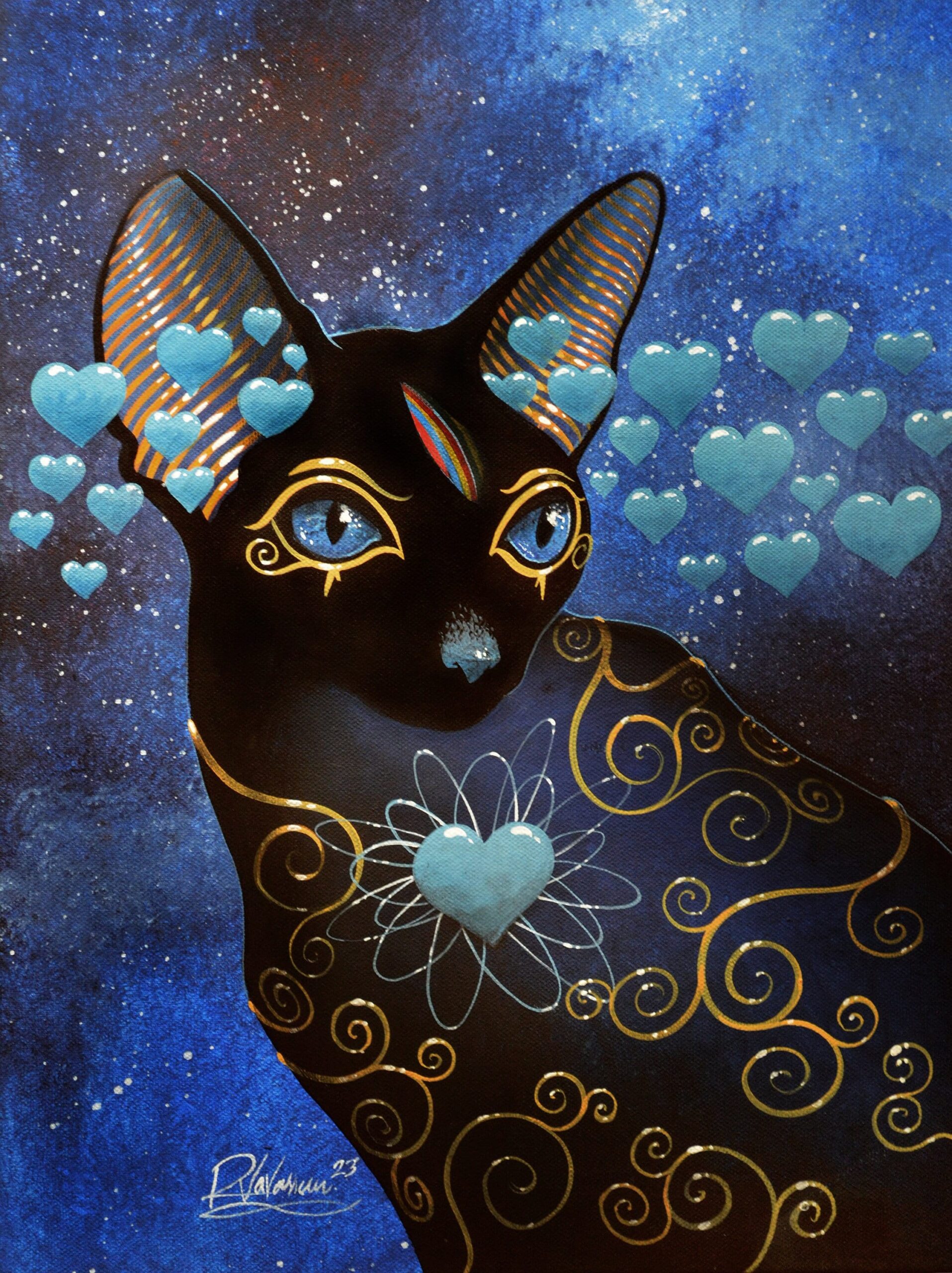
Bastet Blue Heart
A black cat in the formal hieratic posture of Egyptian devotional art faces the viewer with the composed authority of a deity acknowledging its supplicant. The body is adorned with flowing gold spirals and a central mandala heart; clusters of teal and aquamarine heart-shaped gems drift through the surrounding astral blue-black field. This is Bastet as she might have been reimagined at the intersection of sacred geometry and contemporary sentiment: no longer merely the protector of home and hearth but a sovereign of the affective life — a living jewel presiding over the domain of love. Egyptian cat painting, Bastet artwork, gold and blue cat art, mystical feline original, sacred cat acrylic, stellar jewel cat painting.
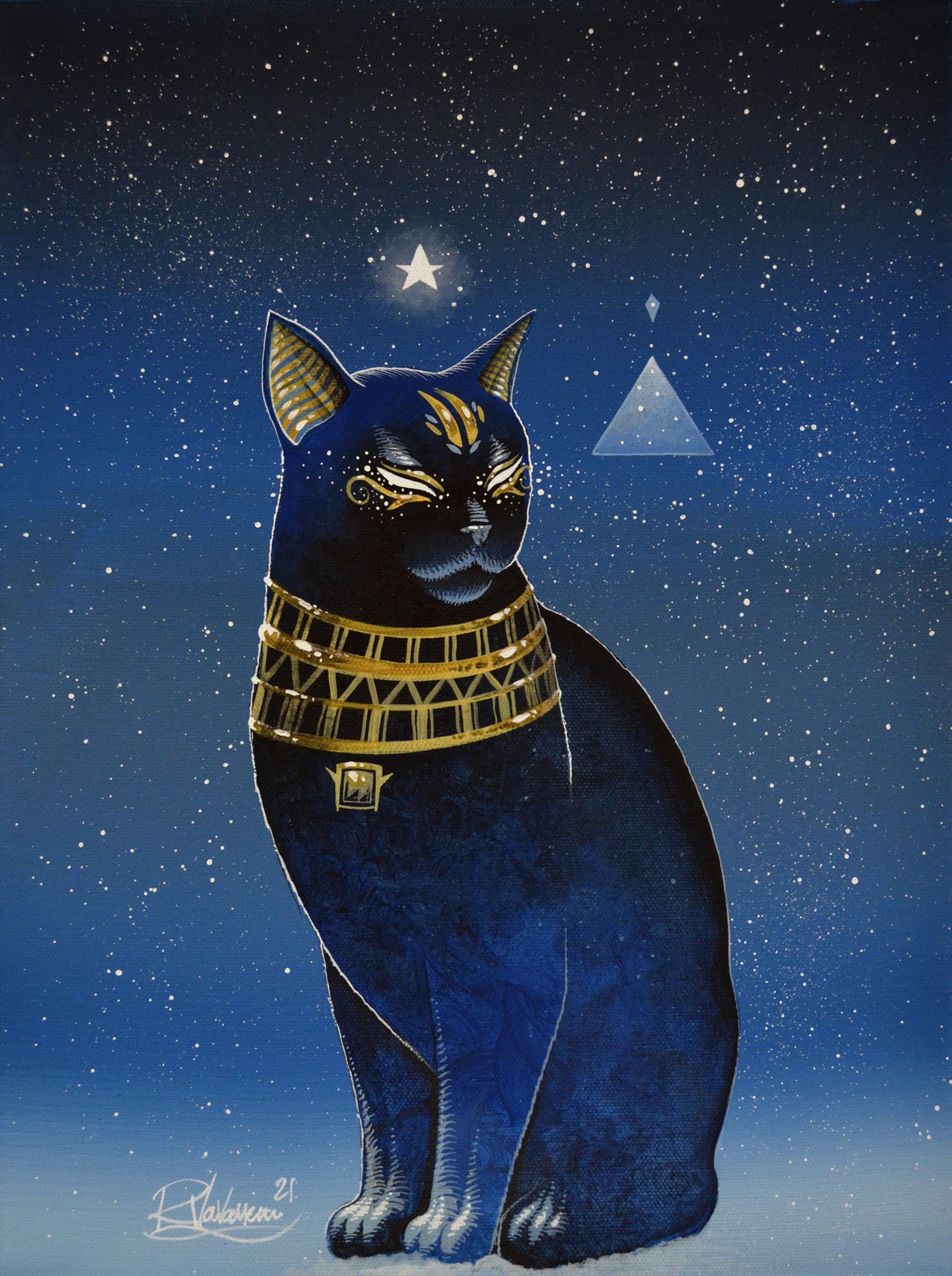
Bastet Cat Hermeticism
A dark blue cat sits in the strict upright posture of Egyptian ritual representation, wearing a gold collar-necklace of intricate workmanship — the vestment of a priesthood rather than the ornament of a pet. Above it, against a field of stars, a glowing white pyramid rises to an apex crowned by a single bright star, its geometry exact, its light unwavering. The composition invokes the hermetic tradition directly: the cat as threshold guardian, keeper of arcane knowledge, occupant of that liminal space between the mortal order and whatever lies beyond it. The painting does not illustrate esotericism so much as embody its atmosphere — formal, exact, charged with occluded meaning. Egyptian cat original, Bastet hermeticism art, sacred geometry cat acrylic, pyramid cat painting, mystical blue cat, esoteric feline artwork.