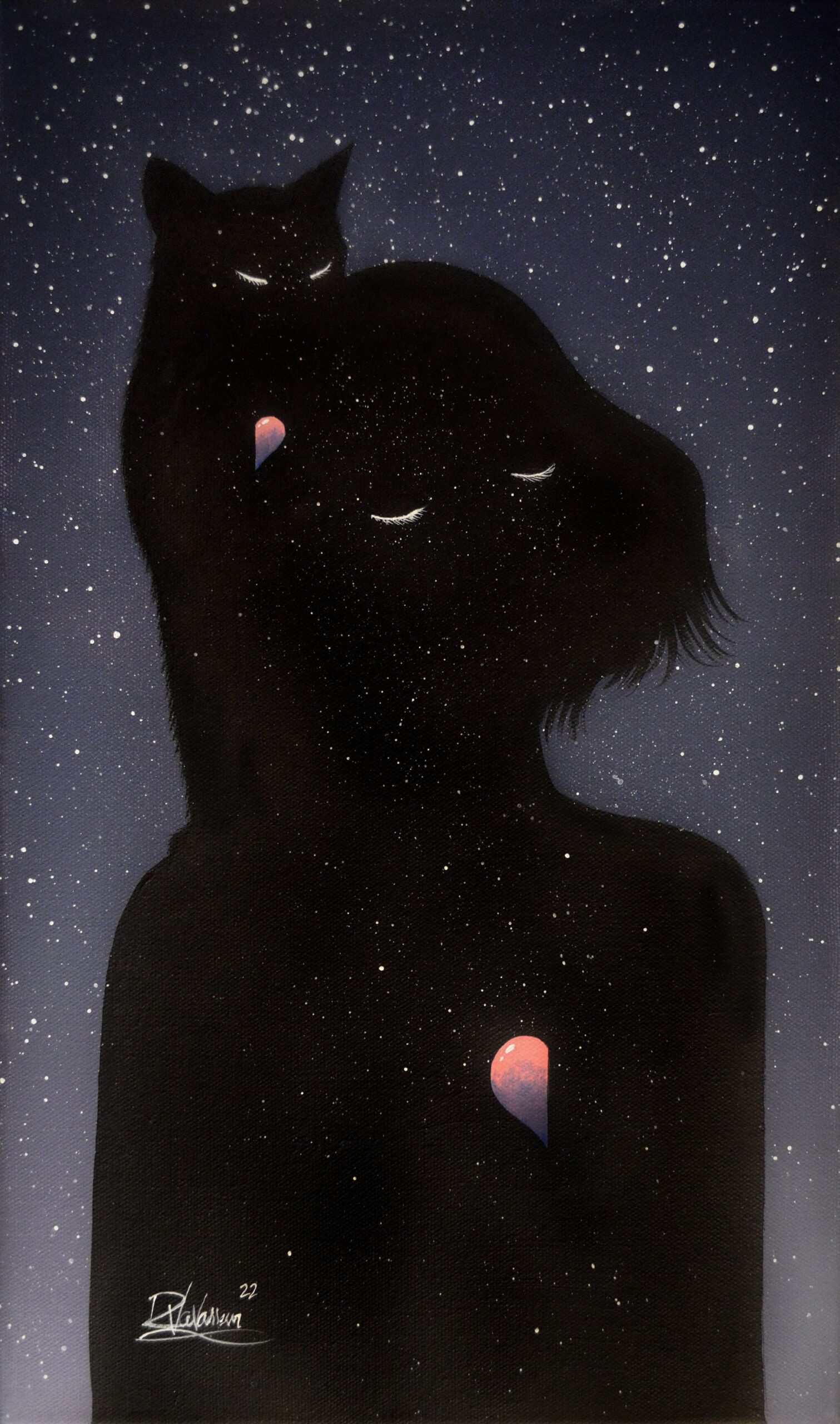
Chapter 1: The Embrace of the Void and the First Glimmer
“At the moment I write this story, a black cat holds me in his gaze — and I cannot say whether I am seeing him for the first time, or remembering him from somewhere I cannot name.”
My name is Raphaël Vavasseur, and if these words ever find their way onto a screen or a crumpled page, it will be because the night itself forced my hand. Here, in this old ochre sandstone farmhouse lost in the heart of the Haute-Provence plateau, where black cypresses claw at the sky like Chinese ink on rice paper bleached beyond recall, I have lived alone for seven years. Seven years in which every dawn has found me bent over a canvas, my back bowed beneath the weight of a talent that refuses to be tamed. My studio occupies the former barn, its century-old oak beams sagging under the burden of unfinished canvases that hang like corpses of dreams. The air always reeks of linseed oil gone rancid; that fine dust of pigment settles on my skin like a second epidermis, a membrane of colour that never quite washes away.
Outside, the countryside is a silent symphony of broken lines. The lavender fields, now dormant in winter, trace phantom mauve undulations beneath the gibbous moon; the olive groves, with their gnarled trunks twisted by centuries of mistral, form tortured arabesques that remind me of my own charcoal sketches—lines that seek ecstasy without ever reaching it. At night, especially when the midnight sky becomes that dome of such deep ultramarine that it brushes against absolute black, the stars light up one by one, like points of pure light cast by a divine brush onto a cosmic canvas. I have spent hours sitting on the worn stone threshold, watching the Milky Way stretch out in a vast sfumato, its nebulae evoking veils of translucent gauze that Turner himself might have envied. “Under the starry countryside sky, the midnight sky shines bright,” I once scrawled in a vermilion-stained notebook, never suspecting that these words would become the title of a confession I had never planned to write.
My life was a permanent chiaroscuro. By day I painted with methodical fury, almost clinical in its rigour: abstract compositions where lines of force intersected at sharp angles, where primary colours—this blood-red cadmium, this abyssal Prussian blue, this luminescent Naples yellow—collided in thick impastos, as though the material itself were screaming its revolt against the flatness of the world. Yet nothing held. Every canvas ended up turned against the wall, its verso covered in notes that only a tormented mind like mine could decipher: “Perspective flees toward infinity, yet the soul remains trapped inside the frame.” I was an artist with an imaginary doctorate, a PhD of solitude, a doctor of invisible nuances and broken harmonies. My intelligence, rare and sharp as a 9H graphite point, gnawed at me from within. I dissected every sunset in terms of colour temperature, every reflection on the neighbouring pond in terms of refraction and saturation; I mentally calculated the golden ratios in the curves of the evergreen oaks, I hunted for divine proportion in the arc of a cloud. And still the masterpiece eluded me. It taunted me from the far shore of my own genius, leaving me in a state of permanent tension, a creative neurosis in which every inspiration was an exquisite pain.
The decorations of my house—if one can speak of decorations—were merely extensions of my inner chaos. On the peeling whitewashed walls I had pinned fragments of old canvases: a torn corner of sky where cobalt bled into pearl grey, a charcoal contour that snaked like an open vein. In a corner of the studio stood an antique easel, its wood cracked by autumn damp, bearing a weathered walnut palette streaked with geological layers of paint: superimposed strata of burnt sienna, luminescent Veronese green, French indigo so dense it seemed to absorb light rather than reflect it. Marten-hair brushes, worn to the quick, lay in chipped stoneware pots; crushed tubes, emptied of their chromatic souls, formed a miniature cemetery on the workbench. And everywhere that smell—that heady fragrance of turpentine and beeswax that had seeped even into the sheets of my narrow bed, as though art itself had decided to colonise my sleep.
That evening, the 14th of March, the sky was of an almost unbearable clarity. I had stepped outside to stand a moment beneath the night sky, leaning against the barn wall, when the darkness seemed to contract. The stars, usually so distant, appeared to descend, their points of light growing sharper, crueller. I looked up and saw, for the first time in years, a constellation I had never noticed: a perfect alignment of three stars forming an isosceles triangle, like a perspective frame drawn by a Renaissance master. My mind—this hyperactive, tormented brain—immediately began calculating the angles, the intersections, the way this celestial geometry could be transposed onto canvas in a composition where vanishing lines converged toward a non-existent vanishing point, a void heavy with meaning. I held my breath, heart pounding with an excitement I had not felt since my last failed exhibition in Paris five years earlier.
It was then that she appeared.
She was walking along the dirt path that borders my property, a slender silhouette wrapped in a black coat that seemed to absorb the lunar reflections. Her steps were silent, almost unreal, as though she glided over the mist rising from the fields. I did not hear her approach; she was simply there, at the edge of the pale yellow light filtering from my studio window. Her face, when she turned toward me, was a living masterpiece: high cheekbones that caught the starlight in a subtle ash-rose gradation, eyes of such deep emerald green they evoked hand-ground malachite pigments, lips that seemed sketched in a single stroke of sanguine. She did not smile at once. She simply tilted her head, as though studying a still-wet canvas.
“You paint the sky, don’t you?” she said in a low, velvety voice with an indefinable accent that blended the rounded vowels of the south and an almost mathematical precision. “I saw it from the road. Your canvases… they breathe as though they want to escape the frame.”
I did not answer immediately. My mind began cataloguing: the curve of her neck formed a perfect 47-degree arc relative to the horizon; the way stellar light played on her black hair created a value contrast worthy of a Rembrandt revisited by Rothko. Who was she? A lost traveller? A hallucination born of too many sleepless nights? Or worse—a muse sent by the gods to punish me for my arrogance?
She took a step closer. “My name is Lira. And you… you are dying by inches in this beauty.”
Her words struck like a dry brushstroke on a virgin canvas. For the first time in years, something inside me—that tormented, hyper-intelligent part that reduced everything to its constituent atoms—felt a fissure. A glimmer. A possibility.
I opened the studio door without a word. The warm light of the oil lamps flooded her face, revealing coppery reflections in her irises, nuances I would never have dared mix on my palette: viridian green blended with bismuth gold, a hint of raw umber for the shadow beneath the lashes.
And it was there, beneath that starry countryside sky where midnight shone with an almost blasphemous brilliance, that everything began to shift.
But that, dear imaginary reader of this journal I never meant to keep, is for the next chapter. For now I close this notebook, my fingers stained with Prussian blue and nascent hope. Tomorrow, perhaps, I shall finally paint something that does not scream with emptiness.
Chapter 2: The Fissure in the Pigment and the Breath of the First Harmony
I did not light the large halogen lamps that evening; no, I left the studio bathed in the sole trembling glow of the old copper oil lamp, the one whose flame danced like an uncertain heartbeat across the waiting canvas. Lira entered without a sound, her coat slipping from her shoulders with the fluidity of a silk drape over a Renaissance model, revealing a crumpled white linen shirt that caught the golden reflections of the wick. The air, suddenly denser, grew heavy with a subtle fragrance she carried with her: a blend of damp earth after dewfall, sun-warmed pine resin, and an almost mineral note, like the scent of quartz rubbed beneath the palm. It was not perfume; it was an elemental presence, a living extension of the countryside itself that seeped into my sanctuary of pigments and emptiness.
She approached the central easel, the one bearing my latest aborted attempt—a large canvas of 180 by 120 centimetres covered in furious impastos where cobalt blue clashed with cadmium red in a war of violent contrasts, without resolution. Her slender fingers, with short, pale nails like polished oyster shells, brushed the still-tacky surface. “There is a fracture here,” she murmured, her voice low and velvety, almost tactile, as though each syllable caressed the air before reaching me. “Not in the material… in the intention. Your lines flee outward, Raphaël, as if you feared the entire universe might close in on you. But look: life itself always seeks coherence. Even in the chaos of the mistral twisting the almond trees, even in the slow decomposition of lavender leaves returning to the earth.”
That vigilant part of me—always scanning, never at rest—began to vibrate with a new tension. I felt, deep in my chest, a diffuse warmth, not the familiar burn of creative frustration, but something more subtle: a quiver, a wave rising along my nerves like a fresh coat of varnish over a dry underlayer. I drew up a worn wooden stool for her, and we sat face to face, separated only by the stained palette that rested between us like a pagan altar. Outside, the wind had risen—a discreet, almost timid mistral that made the oak beams creak and whispered against the studio’s grimy windows. Each gust brought a draught of cold air laden with distant iodine from the mountains, mingled with the woody aroma of the cypresses lining the path. Life outside breathed in slow cycles: the sap rising imperceptibly in the gnarled trunks, the dew condensing on wild grasses, the clay soil exhaling its mineral memory after centuries of rain and sun.
“Tell me, Lira,” I finally articulated, my voice hoarse from having conversed too long only with shadows, “who are you to see so clearly what I hide beneath the layers?” She smiled then—a slow, asymmetrical smile that carved a tiny dimple into her left cheek, a detail my artist’s eye instantly recorded as a perfect rupture of symmetry, an unexpected focal point in an otherwise divinely proportioned face. Her eyes, those living emeralds where the lamp’s flame danced, settled on me with an intensity that was neither judgement nor pity, but a profound, almost cosmic recognition. “I am the one who passes through the interstices,” she replied. “The one who listens to the silence between the stars. You paint the sky, Raphaël, but you forget that the sky is not only above: it is also in the earth cracking beneath your boots, in the beat of your own pulse when you blend titanium white with ultramarine to obtain that pearly grey that evokes an uncertain dawn. Coherence is not in the perfection of lines; it lies in the acceptance of the imbalance that makes everything alive.”
Her words slipped into me like a subtle dilution of pigment in a transparent medium: they softened the rugged contours of my torment without erasing it. I felt, for the first time in years, a physical sensation of release in the muscles of my shoulders, a slow, almost sensual unknotting, as though the accumulated tension in my trapezius—those steel knots forged by sleepless vigils and rage against the canvas—evaporated into a light mist. The studio, usually so oppressive with its walls covered in pinned sketches (studies of cavalier perspective where vanishing lines lost themselves in infinity, palettes of cool tones annotated in pencil: “saturation 72 %, value 18 %, temperature 2100 K”), suddenly seemed to breathe with us. The canvases turned against the wall appeared less accusatory; they waited, like sleepers ready to awaken beneath a new gaze.
We talked for a long time that night. Of life as one great unfinished composition: she spoke to me of the elements answering each other in echo—the water of the neighbouring pond reflecting the constellations in a trembling mirror, the earth absorbing the pigments fallen from my brushes and transforming them into fertile humus, the fire of the lamp consuming the linseed oil and releasing that acrid, sacred smell of creation. I opened a fresh notebook, its pages still crisp, and began to trace, beneath her eyes, not a finished work but a series of exploratory lines: a sinuous arc evoking the camber of her back as she had leaned over the canvas, an intersection of straight lines recalling the geometry of the stars seen earlier, a gradation from Veronese green to burnt sienna to capture the inner light she carried within her. Each stroke of charcoal on the grainy paper produced a soft, almost intimate sound, like a sigh of relief. The sensations multiplied, subtle and intoxicating: the metallic cold of the graphite tip against my pigment-stained fingers, the diffuse warmth rising from the lamp and warming our faces, the barely perceptible scent of her breath, mingling now with turpentine and wax—a fresh, almost saline note, like the air after a distant storm.
For the first time, my rare intelligence, that mental scalpel that dissected everything down to the chromatic atoms, no longer sought to destroy or reduce to its last transparent layer. It sought coherence. It sought to draw the invisible threads together: the void of my solitude to this unexpected presence, the chaos of my furious impastos to a nascent harmony in which every colour would find its resonance, every line its echo in the other. Lira was not an ordinary muse; she was a living catalyst, a disruptive element that reconfigured the very architecture of my inner universe. When she rose to leave, at the first tentative gleams of a reluctant dawn that tinted the sky in a subtle ash-rose, she placed a light hand on my forearm. The contact was electric and soft at once: her cool skin against mine, burning with creative fever, a shiver that travelled up to my nape like a stream of liquid light.
“Tomorrow evening, I will return,” she promised. “And we shall see whether your midnight sky finally agrees to shine from within.”
The door closed behind her. I remained alone, yet not empty. The studio still vibrated with her presence: a subtle olfactory imprint on the air, an unfinished canvas that now seemed to murmur promises instead of screaming its failure. I extinguished the lamp, and as the darkness reclaimed the room, I felt, at the very depth of myself, the first spark of a long-eluded coherence. Life, that great fresco with unpredictable colours, had just offered me a new layer of glaze—transparent, luminous, full of possibilities.
Tomorrow, perhaps, I would begin to paint no longer against the void, but with it. And that thought, dear phantom reader of this journal I write only to exorcise the soul, left me in a state of feverish wakefulness, my heart beating to the slow rhythm of the elements that, at last, seemed to align.
Chapter 3: The Palimpsest of the Soul and the Superimposed Layers of Torment
I awoke that morning—or rather, I clawed my way back from the abyss of a fractured sleep—with the metallic taste of doubt upon my tongue, as though I had spent the entire night chewing pure titanium white, that pigment so opaque it conceals everything without revealing a thing. The studio, that sanctuary Lira had seemed to illuminate with an inner glow the night before, now appeared to me as a crypt of stacked canvases, a mausoleum of my own failures where every dried impasto screamed its betrayal. Outside, the Provençal countryside, usually complicit in my solitudes, had transformed into a hostile landscape: the cypresses, those dark sentinels standing at attention against a sky of merciless cerulean blue, cast long accusatory shadows across the dormant lavender fields, while the mistral—that cruel, pitiless wind—whistled through the joints of the ochre stones like a gust of unanswered questions. Why her? Why now? And above all, who am I — Raphaël Vavasseur, this painter with a phantom doctorate in suffering — to deserve this luminous intrusion into the permanent chiaroscuro of my existence?
The outer world, that vast canvas of existential grisaille, had never spared me. It had already dishonoured me once, in Paris, during that cursed exhibition where my canvases—those compositions in which lines of force shattered into obtuse angles, where blood-red vermilion collided with abyssal Prussian blue without ever finding harmonic resolution—had been relegated to the back of the room, mocked by critics with flashy vocabularies but flat souls. “Too cerebral, too tortured,” they had pronounced, those arbiters of a world that prizes chromatic superficiality over the depth of inner glazes. And here, in this isolated farmhouse, dishonour had mutated into a more intimate, more corrosive incomprehension: why had life, that great fresco of superimposed brushstrokes, chosen to send Lira as an unexpected touch of light upon my accumulated layers of darkness? Was it a cosmic trap, a divine farce in which the stars themselves—that midnight sky I had scrutinised so often—conspired to remind me of my finitude?
I dragged myself to the palette, my trembling fingers brushing the crushed tubes like open veins: the cadmium yellow, so luminous yesterday beneath her gaze, now seemed garish, vulgar, a carnival colour against an inner mourning. That inner obsidian blade launched into a merciless dissection of my own chaos. Who am I? An artist or an impostor? A self-taught exile of form, a hermit of chromatic obsessions, or simply a man shattered by solitude, a human palimpsest where the painted layers of my past—the sepia-tinted orphan childhood, the furious impastos of my Parisian studio years—superimpose in a disorder that refuses coherence? Lira had spoken of accepting imbalance, yet now, in the raw light of day, her words rang like a mocking echo. Turmoil washed over me in waves: an ontological uncertainty that shook the very foundations of my being, like a poorly stretched canvas on an overly rigid stretcher. Why all this? Why this urge to create that arises precisely from the void, from that fissure where the soul bleeds in primary colours? Life, I told myself while pacing the studio in jagged steps, is it not itself an unfinished painting, an infinite superposition of touches where each transparent glaze barely conceals the pentimenti beneath—those regrets that surface in subtle craquelure, those cognitive dissonances which, paradoxically, engender the sacred fire of creation?
I sat on the worn stool, elbows planted on the workbench streaked with raw umber and faded terre verte, and let the inner world surge forth in a torrent of tormented sensations. My heart beat in an irregular rhythm, an existential staccato that evoked the broken lines of my charcoal sketches: a heavy, almost painful pulse in which the residual exaltation of her presence mingled with the abyssal terror of imminent loss. The desire to create, that insatiable monster, arose from the very uncertainty, like a venomous flower sprouting in poisoned soil. I felt, in the depths of my viscera, that perverse alchemy: turmoil as catalyst, incomprehension as a transparent medium that diluted my fears into a new, indefinable hue—a muted ash of the soul, neither black nor white, laden with every nuance of questioning. “Why me?” I murmured to the mute canvases that stared down from the walls. “Why this cruel world, this theatre of shadows where luminous beings like Lira only cross the frames of our lives to leave them emptier after their passage?” Dishonour was no longer external; it was internal, a pictorial pentimento in which I scraped the surface of my ego to reveal the underlying layers of vulnerability: the child who painted with stolen crayons, the adult who had fled the city to avoid the gaze of others, the artist who, despite his rare intelligence, doubted every brushstroke as a blasphemy against the invisible.
Outside, the sun had reached its zenith, bathing the fig trees in a pitiless light that accentuated the cracks in their weathered bark—a living metaphor for my own hide, fissured by decades of unrelenting doubt. I tried to paint, of course; my hands, once sure instruments, seized a marten-hair brush with bristling hairs, and I laid a hesitant stroke on a virgin canvas: a Prussian depth so absolute it seemed to swallow the light, followed by a sanguine line to suggest a feminine silhouette with blurred contours. But the hand trembled. Uncertainty generated a ferocious, almost erotic desire to transcend the chaos: each question—who am I in this indifferent cosmos? Why this encounter that awakens sleeping demons?—became an additional layer on the canvas of my life, a thick impasto that, far from stifling, revealed through transparency the preceding strata. The torment was not sterile; it was fertile, a rich psychic humus in which new ideas germinated, compositions in which vanishing lines converged no longer toward emptiness but toward an incandescent focal point: Lira herself, living enigma, catalyst of my artistic resurrection.
Yet evening approached, and with it the anguish of her possible return. Would she come back? Or was she merely a hallucination born of too many solitary nights, a phantom muse invoked by my tormented subconscious? The cruel world, with its implacable cycles of light and shadow, seemed to mock me: the sky, that promised dome of midnight, was already tinged with crepuscular purple, and I remained there, prostrate, interrogating the distorted reflections in a puddle of spilled linseed oil. That same cutting faculty, turned against me now, descended into verbose self-flagellation: “You are nothing but an assemblage of scattered pigments, Raphaël, a collage of unfulfilled desires in which coherence is but an illusion.” And yet, in this maelstrom of questionings, the desire to create blazed fiercer than ever—a pure blue flame that consumed doubts without extinguishing them, transforming them into raw energy for the canvas to come.
To you, whoever stumbles upon these lines: I close this chapter not in peace but in a vibrant uncertainty. Life, that painting of superimposed touches, deposits within me both torment and hope, dishonour and possible redemption. Tomorrow, perhaps, Lira will cross the threshold once more, and the layers of my soul will at last find their dissonant harmony. Or perhaps not. And in that very uncertainty lies the salt of creation: that exquisite shiver, that vertigo of the painter before the abyss which, paradoxically, summons the light.
Chapter 4: The Horizon That Opens and the Wind of the Great Wide
I am alone now, as I was on that first evening when the midnight sky had shone with an almost blasphemous brilliance above the ochre farmhouse. Lira left at dawn, without theatrical farewell, without promise of return; she simply melted into the mist rising from the terraced orchards, an evanescent silhouette carrying away with her the last touch of human presence. The studio, that womb of oak and stone where I had bled for weeks, rested in sovereign silence. The finished canvases—seven vast compositions, born of our nights of dialogue and my days of torment—stood aligned against the far wall, their surfaces still tacky with fresh varnish, catching the slanting light of dusk like dark mirrors turned inward. Yet I no longer looked at them. My eyes, those exhausted instruments that had mapped so many lines of force, so many gradations of light and shadow, now turned outward, through the great door flung open onto the countryside.
The wind had risen, that pure, sovereign mistral sweeping the Provençal plateaus like a prophet announcing the inevitable. It blew from the northwest, laden with the scent of distant salt and crushed rosemary, bending the cypresses into long living arabesques and setting the lavender fields undulating in mauve waves that seemed to answer a cosmic summons. I stood on the worn stone threshold, arms crossed over my shirt stained with cadmium and burnt sienna, and I waited. Waiting—that great inner tide rising slowly, inexorably, until it submerges the shoreline of the soul. The work was finished—this masterpiece sprung from nothingness, born of the fissure Lira had opened within me, of the superimposition of my torments and her lights. A monumental canvas two metres by three, where the midnight sky burst forth in a vertiginous deep blue, traversed by lines of force converging toward an incandescent vanishing point: a feminine silhouette sketched in transparent glazes, almost translucent, as though she were merely a memory of light upon the material. The colours sang there in a dissonant harmony—blood-red vermilion against luminescent Veronese green, irradiating Naples yellow against the ashen grey of dawn—and yet, now that everything was laid down, the question pierced me like a final brushstroke: would the public be moved by this thing come from the void? Would this composition, sprung from my isolation, my doubts, my nights of doctoral questioning, take its place in the world, or would it remain, like so many before it, a silent cry in the desert of indifferent galleries?
The outer world, that vast ocean of gazes and indifference, suddenly seemed vaster than ever. I imagined the Parisian critics, those arbiters with chiselled vocabularies but flat souls, scrutinising my canvas through their conceptual lenses: “Too cerebral, too mystical, too provincial.” And yet, in this solitary waiting, I felt that the work no longer belonged to me. It had become a living being, a palimpsest where my inner pentimenti superimposed themselves in ultimate layers, ready to face the open sea. Would it find its place? Would it become that fixed star in the sky of art, or would it dissolve into the flux of ephemeral exhibitions? The question, instead of gnawing at me, lifted me; it drove me toward the horizon, as though waiting itself were the final stroke, the sealing varnish that closed the whole.
The clouds were arriving now, driven by the wind of announced success—or at least by the wind of the possible. They massed in the west, billowing masses of silver-grey tinged with crepuscular rose, their contours shredded by the mistral into epic shapes: here the prow of a ghost ship, there a celestial mountain, elsewhere a sail swollen with a divine breath. They advanced toward me, slow, majestic, like a fleet of destiny finally meeting my isolated shore. I was alone, infinitely alone, yet connected by this wind that slammed the barn shutters and carried the last scents of turpentine toward infinity. The wind of success, I told myself, does not arrive in fanfare; it comes in discreet gusts, in clouds that transform before your eyes, in this music that suddenly arose in my head.
Yes, the music. It emerged from the silence like an inner symphony, vast and unbidden, the culmination of a long-nurtured process. First a deep, grave drone, like the distant rumble of an organ in a cathedral of clouds; then high, vibrant strings weaving melodic lines that evoked the arabesques of my brushes on the canvas. A cosmic fugue in which the main theme—that midnight sky shining bright—repeated in infinite variations, mingling the breath of the mistral with the beating of my own heart. It was the sign. The event was coming. Waiting, that great active patience, had at last lifted the horizon itself. I felt, in my bones, that the work would take its place: not through the clamour of crowds, but through that secret resonance that traverses centuries, like a wave that, after millennia of backwash, finally sculpts the cliff.
The sun was descending, setting the clouds ablaze with gold and purple, and I remained there, motionless, eyes fixed on that line where earth and sky melt into an eternal sfumato. The entire countryside seemed to breathe with me: the ancient vines trembled in the wind, the cypresses bowed in reverence, the clay soil exhaled its mineral perfume like a final incense. Alone, yes, but in a triumphant solitude, that of the captain who, after the storm, sees the horizon open before him. The work had been launched upon the great wide of the world; whether it sailed or sank, it had already completed its voyage within me. The music in my head swelled, becoming a full orchestra, a symphony of lines, colours and winds, and I knew, in that precise instant, that the masterpiece had found its place—not in a gallery, but in the infinite where every true creation ultimately dissolves only to be reborn.
“I remember — I have seen that before, somewhere in a black cat’s eyes… a déjà vu?… I don’t know”
A Story by Raphaël Vavasseur, with the help of a black cat
The black cat of this story lives on in paint. You can wander the original cat paintings and the wider collection of feline art — each canvas another night in the same starry countryside.